Showing posts with label Budapest. Show all posts

Wednesday, July 4, 2012

Corruption Probe in Budapest


In Budapest, Corruption Probe in Budapest Amplifies Calls for Reform of Jewish Institutions


By Ruth Ellen Gruber

Jan. 10, 2012

BUDAPEST (JTA) -- A whistle-blowing rabbi and a reform-minded lay leader are at the forefront of new efforts to shake up Hungary’s entrenched Jewish establishment.

Late last year, Rabbi Zoltan Radnoti alerted authorities to complaints that reportedly include embezzlement and tax fraud in the operation of Budapest’s main Jewish cemetery on Kozma Street. This led to a police investigation and an unprecedented raid on Dec. 1 on both the cemetery and the Jewish community offices that house the burial society, as well as a public airing of the scandal in the mainstream media.

“Many people in the Jewish community administration attacked me for airing internal affairs to the outside,” Radnoti, 40, told JTA. “I was told that I draw a salary from the Budapest Jewish Community, so I was disloyal to my employers.”

But, he added, “You have to fight for the truth no matter what. I think this could become the beginning of the cleaning-up of Jewish communal affairs.”

Joining Radnoti is Andras Heisler, a former president of the Federation of Jewish Communities in Hungary, or Mazsihisz, the official umbrella of the Neolog community, a moderate reformist movement to which the vast majority of affiliated Hungarian Jews belong. The Jewish community in Budapest, home to 90 percent of the country’s Jews, is the largest member of Mazsihisz.

Mazsihisz officially represents the interests of Hungarian Jewry to the government and is responsible for the annual distribution of millions of dollars of government grants and Holocaust compensation funds to Jewish organizations. Critics have long called for a reform of its financial and administrative operations, accusing the organization of being undemocratic, unrepresentative, monopolistic and opaque.

Managing director Gusztav Zoltai, 76, has been in office for two decades and has come under particularly sharp criticism for his leadership style and firm grip on power.

“Zoltai manages to hold on to power by switching people in key positions who are somehow dependent on him,” Janos Gado, an editor at the Jewish magazine Szombat, told JTA. Gado and others say that many, if not most, of those who elect communal leaders are financially dependent on Zoltai and the other office-holders they are electing.

Zoltai, who along with current Mazsihisz President Peter Feldmajer declined to be interviewed, was elected managing director in 1991, when the organization was first established to replace the communist-era Jewish body. A child survivor of the Holocaust who lost most of his family in World War II, he had worked previously as the stage manager of a theater.

Last spring, in a case reported in the Hungarian media, Radnoti and Heisler charged that the election of Jewish community officials had been manipulated to prevent changes in the top leadership -- and specifically to prevent Heisler from becoming a delegate to the general assembly, the body that elects the top officials, including Zoltai.

Heisler had resigned as Mazsihisz president in 2005 following his attempts to overhaul the organization were thwarted and his calls for Zoltai’s resignation were rebuffed. But in December, with Radnoti’s support, he was elected to the Mazsihisz board, and now he is hopeful that, with allies like Radnoti, he can make a renewed push for reform.

“If Mazsihisz survives, it will survive in a different form,” Heisler said. “The way it operates now, it can’t continue. Zoltai must go; if he leaves there is a chance.”

Mazsihisz has come under particular criticism for a lack of financial transparency -- criticism the cemetery scandal seemed to bear out. Radnoti claims the investigation and police raid were sparked by material he furnished that document transactions without receipts, double-entry bookkeeping, sales of nonexistent grave sites and other abuses.

“It’s the tip of an iceberg,” said Gabor Miklosi, an investigative journalist who saw Radnoti's documentation and broke the story on the popular Index.hu website.

After the allegations surfaced, Mazsihisz issued a statement saying that in its own internal investigation. the Budapest Jewish community had uncovered one case of abuse several months earlier that had involved a false receipt. The director of the cemetery was fired after repaying the money, the federation said.

“The irregularities that were committed did not involve the invoicing system of the funerary department” of the burial society, said the statement.

Sociologist Andras Kovacs, who co-authored a report last year that called for “urgent” reform of Mazsihisz, said the manner in which communal funds are distributed is “a totally dark area.” The report, issued in September by the London-based Institute for Jewish Policy Research, called for structural changes to ensure greater transparency and equitable distribution.

“There are a lot of rumors and gossip,” Kovacs told JTA. “Some former officials of the community suggested several times to launch an independent audit, but it never happened. It is always suggested that to raise questions about this could aid anti-Semites by putting the community in a bad light.”

In recent months, the government has been conducting negotiations that could lead to the withdrawal of some funding from Mazsihisz.

Under a new law, the state recognizes three official streams of Judaism corresponding to the three that existed prior to the Holocaust: Neolog, represented by Mazsihisz; Orthodoxy, whose presence in Hungary is tiny; and the so-called “Status Quo,” now known as the Unified Hungarian Israelite Community, or EMIH. Of the three, only Mazsihisz can currently receive direct government subsidies and collective compensation for unclaimed Jewish assets seized by the communists.

Several Jewish groups are now pressing to obtain direct government funding rather than be obliged to obtain funding doled out by Mazsihisz, which says it will fight any such reallocation.

Thursday, September 16, 2010

Ruthless Cosmopolitan -- Savoring "goulash Judaism" in Budapest

Sharansky nails a mezuzah to the doorpost of the new Israeli Cultural Institute in Budapest. Photo (c) Ruth Ellen Gruber

 My latest "Ruthless Cosmopolitan" column for JTA recounts some of my experiences at Rosh Hashanah this year in Budapest.  A lot more was going on of course, but I would have needed a clone....

Savoring "goulash Judaism" in the Hungarian capital


By Ruth Ellen Gruber


JTA -- Sept. 16, 2010


BUDAPEST (JTA) -- I always try to spend at least part of the High Holidays in Budapest, so I can sample some of the spicy mixture that characterizes the Jewish experience in the Hungarian capital.
As many as 90,000 Jews live in Budapest, the largest Jewish population in any central European city. The vast majority are unaffiliated -- and probably always will be.
Those who do identify as Jews, however tenuously, have an evolving choice of public and private, religious, cultural and secular ways to express or explore their identity.
Gastronomic, too: This year, one friend made challah for the first time to serve at the holiday dinner, and a downtown restaurant even offered a special Rosh Hashanah menu.
Call it "goulash Judaism," if you will -- a simmering mix whose disparate, and often fractious, components combine to form a highly seasoned whole.
Events and observances this year bore witness to the growing array of Jewish options, both inside and outside traditional settings.
The week leading up to Rosh Hashanah, for example, saw the conclusion of the city's 13th annual Jewish Summer Festival, a 10-day series of performances and other events, including a book and crafts fair, that drew thousands of visitors. Also that week, an ambitious Israeli Cultural Institute opened in a refurbished building at the edge of the main old downtown Jewish quarter.
And further afield, in the Obuda district in the northern part of the city, a 190-year-old synagogue that had been used for decades as a state TV studio was rededicated as a Jewish house of worship.
Rented from the state and restored by Chabad, the synagogue will form part of Chabad's growing local network.
Foreign VIPs were in town for all three occasions.
The Jewish Summer Festival culminated with a well-publicized concert by the Chasidic reggae rapper Matisyahu in a major city event arena.
Jewish Agency Chairman Natan Sharansky affixed the mezuzah to the doorpost of the Israeli Cultural Institute, which was largely funded by the agency. Institute director Gabor Balazs said the institute's aim was to introduce and popularize Israel's "mosaic-like" culture to the Jewish and non-Jewish public at large.
And Israel's Ashkenazi chief rabbi, Yonah Metzger, joined Chabad rabbis in cutting the ribbon at the Obuda synagogue.
"This is the best possible answer to what the Nazis did," Metzger told the crowd of 1,000 or more, including Hungarian government and religious leaders, attending the ceremony. "Fifty years after the last time Rosh Hashanah was celebrated here, it will be celebrated here once again."
My own holiday observances also reflected new choices.
I usually attend High Holidays services at one of the 15 or so mainstream synagogues active in Budapest, or sometimes I "synagogue hop" to two or three shuls. Most of them belong to the Neolog movement -- the Hungarian variant of Reform Judaism that is the country's dominant religious stream. But there are also several traditional Orthodox synagogues, as well three or four now affiliated with Chabad.
This year I chose to avoid the mainstream. I sampled Rosh Hashanah services at two small alternative groups -- Bet Orim, one of Budapest's two American-style Reform congregations, and Dor Chadash, a young people's minyan associated with the Masorti, or Conservative, movement.
As neither Reform nor Masorti is recognized by the Hungarian Jewish Federation, both operate outside the umbrella of establishment Jewry.
Bet Orim celebrated a formal service in the auditorium of the Budapest JCC, while Dor Chadash held a more informal gathering in the living room of the local Moishe House, a downtown apartment that serves as a combination residence and center for Jewish educational encounters.
Each group numbered about 30 or 35 people, and both offered an American-style egalitarian Jewish prayer experience that is alien to mainstream Hungarian Jewry.
At Bet Orim, in fact, a young woman named Flora Polnauer served as the cantor for High Holidays services.
"It's the first time that a Hungarian Jewish woman has fulfilled this role," Bet Orim's rabbi, Ferenc Raj, told me proudly.
Raj, a native of Hungary, moved to the United States decades ago and is rabbi emeritus of Congregation Beth El in Berkeley, Calif.
"We are making history tonight," he said.
I had met Polnauer before under quite different circumstances. The daughter of a rabbi, she sings with several local music groups, including hard-driving Jewish hip hop bands.
During the service, dressed in white, she chanted the familiar melodies in a lilting voice. But she looked a little nervous and was clearly moved by the experience.
"I really feel we deserve the Shehecheyanu!" she exclaimed at the end, referring to the blessing recited to mark special occasions and moments of joy.
We all joined in and chanted it with her: "Blessed are you, O Lord, our God, sovereign of the universe who has kept us alive, sustained us, and enabled us to reach this season."

Friday, July 23, 2010

Budapest -- Progressive Jewish Music Scene

My latest JTA piece explores the progressive Jewish music scene in Budapest, ahead of the Bankito Festival in August. I have blogged about some of these people in the past on my Jewish Heritage blog.

Jewish fusion music key to Budapest’s ‘Jewstock’ festival

By Ruth Ellen Gruber · July 22, 2010

BUDAPEST (JTA) -- Flora Polnauer, 28, tilts back her head, half closes her eyes and hums a few bars of a song by her hip-hop/funk/reggae band HaGesher.
The song is "Lecha Dodi," the Shabbat evening prayer -- sounded over a Yiddishized version of the Beatles song "Girl." It's just one of the many unconventional songs of the band, whose vocalists rap their own lyrics in Hebrew, Hungarian and English.
"It's modern Jewish music because it's influenced by Jewish things, but it's not the replaying of old Jewish songs," says Daniel Kardos, 34, a composer and guitarist who plays with Hagesher and several other bands. "I pick up many things and mix them."
Hagesher is one of about half a dozen bands in this city of European Jewish cool blending jazz, hip hop, rap and reggae with Israeli pop and traditional Jewish folk tunes and liturgy to form an eclectic urban sound.
"It's a big mix of contemporary Jewish musical identity," said vocalist Adam Schoenberger, the son of a rabbi. "All of us find Jewish culture very important. Hagesher is a platform for us to articulate musically our different musical interpretation of Jewish cultural heritage."
As the program director of the popular Siraly club, whose dimly lit basement stage is a regular venue for Hagesher and other groups, Schoenberger, 30, is a leader in Budapest's Jewish youth scene. He is also one of the organizers of Bankito, sometimes referred to as "Jewstock" -- a youth-oriented Jewish culture festival Aug. 5-8 on the shore of Bank Lake, north of Budapest.
Bankito includes concerts, exhibitions, performances, workshops, seminars and lectures, a poetry slam, sports events, movies, and Jewish and interfaith religious observances. A number of events at this year's festival will highlight Roma, or Gypsy culture, and focus also on social and civic issues such as the rights of the Roma and other ethnic minorities.
Music is a highlight of Bankito. Hagesher, the Daniel Kardos Quartet and other Jewish bands such as Nigun and Triton Electric Oktopus will perform. "We're at a fascinating moment in Jewish music: It's hip again," said Michigan's Jack Zaientz, who authors the Teruah Jewish music blog. "There's an amazing gang of musicians who are young, smart, urban and Jewish, and making their Jewish identities a core part of their music and stage identities."
The Budapest musicians take their cues from Jewish bands in North America, Paris, London and elsewhere that also experiment with new forms and fusions. Among their models are John Zorn, the avant-garde composer who has promoted "Radical Jewish Culture" on his Tzadik label since 1995, DJ Socalled and Balkan Beat Box, and Orthodox reggae star Matisyahu and rapper Y-Love.
Trumpeter Frank London, who regularly tours Europe with the Klezmatics and other bands, has had a particularly strong impact with his mash-ups of klezmer, Balkan brass and even Gospel.
"Everyone is influenced by Frank London through the Klezmatics," said Bob Cohen, a Hungarian-American musician and writer who has lived in Budapest since the 1980s. "But another big influence in Hungary is Israeli raves on Tel Aviv beaches."
"I played at Jewstock a couple of years ago," Cohen said. "People there had an academic interest in klezmer, but what they want is to go out and rave."
In some ways, Cohen said, the new Jewish music scene in Budapest developed as a reaction to a more traditional klezmer music scene that many young people now perceive as part of the stuffy mainstream establishment. The Budapest Klezmer Band, for example, the city's best-known Jewish music group, performs internationally in opera houses and concert halls as well as theaters and mainstream festivals. Formed in 1990, the band also collaborates on elaborate klezmer stage productions and ballets.
"The new Jewish music scene is a party scene, not a concert scene, and the older generation doesn't relate to it," Cohen said. "In a way, they want an art form that won't be understood by the traditional Jewish establishment."
In many ways, Kardos exemplifies both the musical variety and the variety of influences that help shape the scene.
In addition to Hagesher and his own quartet, he composes film music and plays with several other bands. One of them, Shkayach, is a collaboration with Polnauer, a rabbi's daughter and powerful vocalist who raps with Hagesher and other groups. Shkayach forms a contrast with their rap and progressive jazz work by creating an intimate acoustic sound based on traditional Yiddish and Israeli melodies.
Kardos attended a Jewish high school in Budapest and made aliyah after graduation. In Israel, he learned Hebrew and studied jazz at the Rubin Academy of Music in Jerusalem. But like many young Hungarian Jews who moved to Israel in the 1990s, he decided after three years to return to Hungary, where he continued his studies.
It was only back in Budapest, Kardos said, that he realized the importance to him of both Jewish music and his own Jewish identity. "It was strange because when I was in Israel, I wasn't open so much to the Jewish musical traditions," he said. Away from Israel, though, Kardos said that "I realized that it was more important than I thought. I was very young when I was in Israel, and I didn't realize that it's very important to be Jewish and have all these traditions."
He added, "I think I was too young for the music, too. After some time I realized that when I hear those Eastern melodies, I just feel like home. It's so natural to me. Like being in a swimming pool and floating.

Read story at JTA.org

Friday, June 4, 2010

Hadassah Magazine: Budapest

This article of mine was published in Hadassah Magazine in December/January.

Author's name image
 
Ruth Ellen Gruber
From Hadassah magazine, December 2009/January 2010 Vol. 91 No. 3

It is edging toward midnight, and a smoky haze clouds the Sirály café in downtown Budapest’s old Jewish quarter. At wooden tables, young people nurse beers or espressos, while techno-punk music throbs beneath the buzz. A few people sit alone, peering intently at their laptops, taking advantage of the free Wi-Fi service.
It is a typical scene in one of the many crowded, youth-oriented cafés that have cropped up in recent years in this funky, inner-city neighborhood.

But a few things set Sirály apart.
For one, there is a mezuza prominently displayed on its front doorpost. Scattered leaflets advertise a Jewish culture festival, an alternative Jewish theater and a concert by a klezmer-hip-hop-punk band. And upstairs, off a lounge, is an office of Marom Budapest, the youth organization of the Masorti (Conservative) movement.

Hungary has the largest Jewish population of any once-Communist state outside the former Soviet Union, with as many as 90,000 Jews in the capital. Twenty years after the fall of Communism, young Jews in Budapest are staking a claim in their identity in bold new ways that are changing the face of Jewish life in the city. Call it Generation J on the Danube.

The institutions that were the hallmarks of the first decade of the Jewish revival still exist—and in many cases continue to flourish. These include more than a dozen synagogues in the city; three main day schools; the Jewish University; the all-purpose Balint Haz Jewish Community Center, opened in 1994; the Jewish Cultural Association (www.mazsike.hu); and publications such as the independent Szombat monthly.

But a host of other Jewish initiatives, projects and organizations now thrive alongside them.
The range is vast. Its scope reflects a dynamic diversity in a generation that rejects definitions of Jewish identity based on the Holocaust, shtetl nostalgia or conventional religious practice, and increasingly seeks models in the Jewish lifestyles found in New York, Paris or Tel Aviv.

“The Jewish youth scene includes people who come from traditionally self-identified families and people who discovered Judaism after 1989,” said Bob Cohen, a Hungarian-American Jewish musician who has lived in the city since the 1980s and fronts the klezmer band Di Naye Kapelye. “Some spent a few years in Israel, some found that local political anti-Semitism drove them to a Jewish sense of community, some simply think it is cool to have an identity bigger than the one afforded them by the ever narrowing self-definition of ‘Hungarian.’”

Youth-oriented Jewish initiatives run the gamut from small, unaffiliated minyanim that meet in private apartments followed by Friday-night dinners to avant-garde culture festivals. For example, a three-day Bánkitó festival was held at a lake in northern Hungary this past August. It featured jazz, funk, klezmer, hip-hop and fusion concerts by local groups as well as exhibitions, films, lectures and workshops. There are Jewish theaters, such as the Golem Theatre and the Budapest Jewish Theater. And a Moishe House, a combination dorm and community center, opened in the old Jewish quarter in September.

Educational opportunities alone include academic programs at Central European University and Eötvös Loránd University, Torah study groups, Jewish lecture series, student clubs and an annual Limmud gathering that in 2008 drew 300 participants.

“People are still just as much looking for new forms to express their Jewish identity as they were in 1989,” said 33-year-old Bruno Bitter, who runs a Jewish pop cultural blog called Kajmánsziget (http://kajmansziget.tumblr.com). As elsewhere, the Internet is another popular forum for Jewish expression and there are a host of Hungarian blogs and Web sites, such as Jewish Meeting Point (www.jmpoint.hu) or the music site Jew Box (http://jewbox.hu).

Sirály, the Bar Ladino café, also located in the old Jewish quarter, and several other new clubs and eateries have become popular meeting points where young Jews can hang out with peers. Open to all, “they are not Jewish places per se, but I would call them Jewish-friendly,” said 29-year-old Adam Schonberger, who helps run Sirály; he also plays in a klezmer-fusion-hip-hop-punk band called Hagesher (www.myspace.com/hagesher). “[The clubs are] a very good and very healthy environment for Jews to live their Judaism, to be happy they are Jews.”

Unlike the sometimes kitschy Jewish cafés that cater to tourists in Krakow and other East-Central European cities where few Jews live, there is nothing nostalgic about these venues—and often nothing overtly Jewish. The décor of the Szoda café, which is owned by two Budapest-born Jews who lived in Israel for a time, features manga cartoon designs, 1960s retro furniture, an orange color scheme and a basement dance floor.

A number of venues offer Jewish programming. Sirály, for example, is a cross between a pub and cultural center. Managed largely by Marom, it hosts exhibits and other events, including performances in its basement theater (www.siraly.co.hu). The Spinoza coffee house and theater, a few blocks away, also features Jewish-themed events, but mainly targets an older crowd (http://spinozahaz.hu).

Last Hanukka, an eight-day festival at Sirály featured experimental performance groups and music as well as lectures on fried foods and the holiday, a round-table discussion on Jewish identity and a talk on charity by local rabbi Istvan Darvas of the Nagyfuvaros Street synagogue. Café service was halted each evening to chant the blessings and light candles on a menora set up on the bar.

“Having an actual space that reflects a community’s needs helps cement an identity,” said Cohen. Sirály, he quipped, has a winning formula to attract young people: “Jewish punk rock, a bar and hormones.”

In many ways, young Jews in Hungary are trying to answer the same basic questions faced by their parents and older siblings in the years after the Iron Curtain came down: What does “Jewish” mean? How can one be Jewish? What are the prospects for a viable Jewish future?

Thanks to the efforts of organized Jewry and the first generation of outreach programs supported by the Joint Distribution Committee, Chabad, the Ronald S. Lauder Foundation, the Jewish Agency and others, there have been myriad ways to experiment over the years.
 
“When I was growing up, exploring Jewishness was [part of] a cool new identity,” said 31-year-old Anna Haraszti, a math teacher. Her parents are Jewish, but she grew up with little knowledge of Judaism and only began taking interest in it in her teens.

“Western [Jewish] culture was so attractive,” she said. “There was free stuff, gifts, camps—a group identity, something that our parents just didn’t get. It was a way to rebel….”
Haraszti tried synagogues, a Jewish summer camp and various other organizations. She also tried Chabad, which has had an active presence in the city since the late 1980s, “because,” she explained, “they were willing to teach without asking for enthusiasm and without giving you the depressing ‘We live to remember the Holocaust’ angle.”

Today, she finds her comfort zone by frequenting Sirály and other informal spaces where young Jews gather simply to connect.

Others, however, have embraced religious practice. Some have formed their own congregations or meet with friends in informal prayer and study groups. Many are drawn to two or three established synagogues with sympathetic young rabbis.

“It is not hard to be Jewish in Budapest,” said Adam, a 21-year-old university student who prefers not to disclose his full name. “There are a lot of possibilities here.”

Born little more than a year before the Iron Curtain came down, Adam attended Talmud Torah classes and celebrated his bar mitzva. Like hundreds of other Jewish children, he also spent part of each summer at the JDC/Lauder Foundation Jewish summer camp at Szarvas in southern Hungary, a flagship outreach program that opened in 1990 and is still going strong. It hosts some 2,000 children and teens each summer, about half from Hungary and half from other countries.

Years later, Adam was so moved by a cantor’s singing at his grandfather’s funeral that he decided to become a cantor himself. He now studies Torah with Darvas and is enrolled at the rabbinical seminary that forms part of the community-run Jewish University. There are half a dozen students in his class, he said, two of them taking the cantorial course.

Adam, who attends the Nagyfuvaros synagogue, located in a working-class downtown neighborhood, plans to stay in Budapest and help foster religious education and practice. “It’s important to support Jewish life here,” he said.

Still, many young Jews chafe under the templates for observance and identity laid down by the Jewish establishment and are turned off by communal politics or personalities.
Bitter ran an iconoclastic blog, www. judapest.org, for four years. “I founded Judapest as a form of escapism from Hungarian Jewish life,” he said. “I was inspired by other places and wanted to share the joy of those other realities and experiences.”

Judapest’s antiestablishment attitude toward what it dubbed the “worn-out” Hungarian Jewish mainstream gained it a loyal following, with as many as 3,000 hits a day.

It described itself as “a grass-roots online and offline community” aimed at uncovering “the relevant, the stimulating and the cool in the Hungarian Jewish Experience.” In addition to the blog, it sponsored brunches and other events and published a successful Jewish cookbook, Fuszer es Lelek (Spice and Soul) by Eszter Bodrogi, that combined kashrut with haute cuisine.

Bitter’s decision to shut down Judapest in January 2009 to concentrate on his family and career as a market researcher initially left many followers bereft. But a few months after closing Judapest, Bitter started Kajmánsziget, which he called a “microblog” aimed at posting “fun links, light stories, goofy Jewish videos.” It is not a continuation of Judapest, he said, whose content was heavy on opinion pieces, debates and social and cultural commentary.

“There are many dozens of people claiming that Judapest had changed their lives…,” he said not long after he closed the blog. “I meet people all the time in their thirties who say that this was their first viable, attractive contact with Judaism. People don’t find answers in aliya and do not find answers in Chabad. There are many new organizations, but people are still looking for answers.”
Whether the plethora of nontraditional choices now on the Budapest Jewish menu can provide those answers remains to be seen.

“A lot of people don’t know what is Jewish. They are not interested in learning; they are only interested in self-expression,” said lawyer Agnes Peresztegi, an observant Jew who eight years ago helped organize the Pesti Shul, an independent modern Orthodox congregation.
The past two decades have seen a bewildering host of Jewish initiatives come and go, becoming popular and then fizzling out when resources dried up or leaders lost interest or, as with Bitter and Judapest, simply moved on. New organizations, individuals and initiatives then emerge to fill the gaps, in a process of continuing turnover.

In addition, noted Kata Zsofia Vincze, who has studied both Jewish outreach movements and the contemporary Jewish scene in Hungary, “it is difficult to find permanent support. Most sponsors help project by project, and they expect these institutions to one day become self-maintaining.
“But they will never become self-maintaining,” she added, “because, in Hungary, there is almost no [concept of] supporting my community, in donating time, energy and money for the community.... This has to do with the lack of secure, permanent financial support, but also with constant inner conflicts and jealousies.”

“There are a lot of organizations that deal with entertainment,” said veteran community activist Mircea Cernov. “This and the provision of services for free or at a cheap price answers some needs. At the same time, this has nothing to do with learning, community research and development, the development of young leadership or capacity building for a sustainable community.”

Cernov works with several new outreach and education groups that have joined traditional players like the JDC in supporting new youth initiatives and fostering a deeper sense of identity. These include the Beit Israel Israeli Cultural Institute, Limmud Hungary and Haver Foundation, which promotes interreligious dialogue and teaches both Jews and non-Jews about Jewish culture, heritage, history and religion.
This year, Haver and three other organizations in Budapest—Marom, Jewish Meeting Point and the Jewish studies program at Central European University—were chosen for inclusion in Compass, a new guide on the model of the American Slingshot guide, that singles out 36 of what it calls “Europe’s most vital, innovative, effective and sustainable Jewish organizations and programs.”

Edward Serotta, who directs Centropa (www.centropa.org), a Vienna-based education and research center on Jewish life in central Europe, is optimistic about the future, if only because the sheer number of Jews in Budapest provides a viable critical mass. He sees the ebb and flow of organizations and activities as part of an ongoing process. “In the 21 years I have been involved with this community, I have seen Jewish organizations...rise and fall,” he said. “What makes Budapest so different is that there are so many of them. Two very successful Jewish schools see more than 1,000 Jewish children daily, there’s a plethora of youth-oriented organizations....

“Just as important,” he added, “there are synagogues where, on any given Friday evening, there are upwards of 100 people and the number of congregants under the age of 7 is far greater than those over 70.

“Even if the core of all those who actually attend these schools and events numbers between 5,000 to 10,000,” he said, “that still makes Budapest as active a community as any of its counterparts in the West.”

Back at Sirály, 30-year-old Robert Vajda sips a drink and surveys the busy scene. Bearded and wearing an embroidered kippa, Vajda embodies both the brashness and the complexity of the new era of Jewish choices in the city. He is the director of the Budapest Jewish Theater, a low-budget troupe whose productions often deliberately provoke: Last year, hooded protestors broke up the performance of a pornographic parody of Hungarian high culture.

Vajda is an alumnus of one of the city’s Jewish day schools and attends services at Nagyfuvaros synagogue. It was he who chanted the blessing and lit the candles in Sirály’s bar-top menora at Hanukka.

“Who is a Jew? I am,” he said, smiling. “What is being a Jew? It is what I do.”

Thursday, April 1, 2010

Latest Centropa column -- Budapest

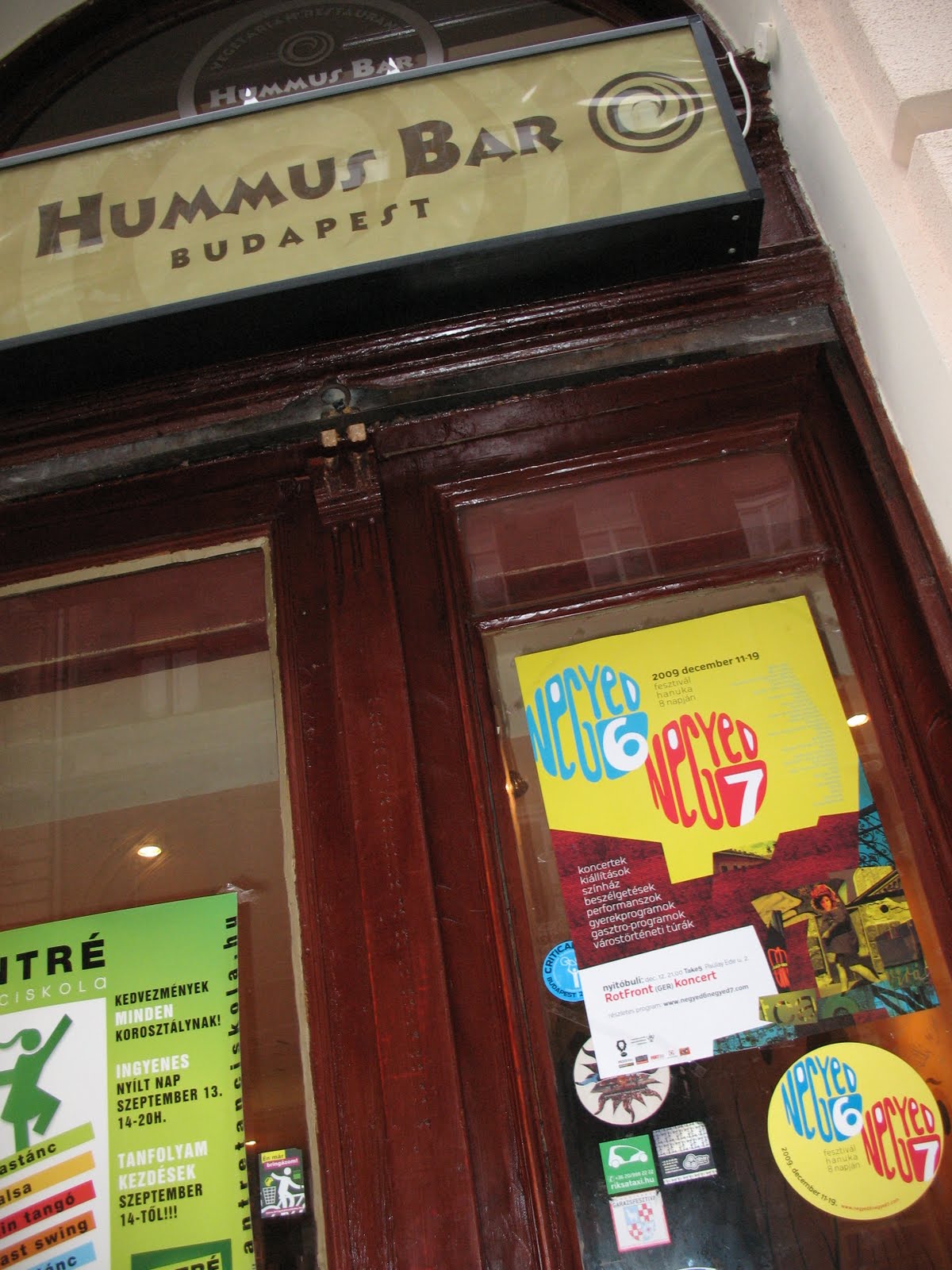
 The Hummus bar on Kertesz utca. Photo (c) Ruth Ellen Gruber


My latest travel column for Centropa.org is a guide to some of the cafes and restaurants I like to hang out in  in Budapest's old downtown Jewish quarter.

Budapest's Seventh District Wakes Up
By Ruth Ellen Gruber


BUDAPEST -- The last time I wrote about Budapest on Centropa I provided an itinerary of Jewish sights and resources, most of them in and around the city's Seventh District, the old downtown Jewish quarter anchored by three grand synagogues forming a so-called "Jewish triangle." 
That was eight years ago, and the former Jewish quarter still had the reputation of being one of the city's poorest inner districts. There were some signs of incipient gentrification, but World War II bullet holes pocked many crumbling facades, vacant lots yawned, and the grimy streets were dark and uninviting. A lot has changed since then.
Much of the District is still neglected. But already at the end of 2007 the New York Times ran a travel story called "Out of Darkness, New Life" that described how the district's "history and recent rise to trendiness" evoke "comparisons to the Lower East Side of New York." A recent issue of Time Out Budapest magazine went even further, terming the Jewish quarter a major city "bar vortex." In fact, the district burgeons with new cafes, clubs, bistros and wine bars that attract a young, hip -- and often Jewish -- crowd.
At the same time, though, this type of growth has been paralleled by controversial urban renewal projects that have seen many old buildings torn down and replaced by rather soulless modern structures.  A citizens group, OVAS, has been formed to lobby for the protection of what remains -- particularly in light of real estate corruption involved in some of the development schemes. The Mayor of the Seventh District himself, in fact, was jailed last year on suspicion of bribery and abuse of office related to property transactions.
I've maintained a small apartment in the Seventh District for more than a decade. Though I only spend part of my time here, I've been observing the changes in the quarter up close; after all, it's my neighborhood.
In particular, I enjoy the new venues and Jewish haunts that have nothing to do with a nostalgic sense of a vanished past but everything to do with how Jews in Budapest -- and particularly young Jews in Budapest -- are experimenting with ways to build a lively present and, one hopes, a sustainable future.
With this article, I would like to introduce readers to some of the haunts in and around the Jewish quarter that I tend to frequent: whether for breakfast cappuccino or afternoon espresso, for an inexpensive lunch, or for dinner or late night drinks and conversation. Or simply as somewhere to sit and use the free WiFi internet that most venues in the district seem to offer.
As I noted in my earlier Centropa article on Budapest, the Seventh District was the first and most important Jewish quarter in Pest, the flat part of Budapest that spreads out on the eastern bank of the Danube.
Today's downtown Deak Square and the massive red brick Madach apartment complex occupy the site of Orczy House, a vast structure built in the 1700s that was a central focus of Jewish life in Budapest throughout the 19th century.  Orczy House was demolished as part of an urban renewal project in the 1930s. Before that, it served as a self-contained warren of synagogues, study houses, apartments, baths, restaurants, cafes, shops, warehouses, and workshops: the place where many Jews from the provinces first found a home when they moved into the big city.
The broader Jewish quarter eventually spread out from here, with Kiraly street, at the edge of the Seventh, becoming its major commercial avenue, a heavily trafficked thoroughfare lined by many fine neoclassical buildings.  The back streets branching off Kiraly street into the Seventh comprised a dense network of shops, artisans' workshops, and tenements built around connecting courtyards encircled by balconies and tiny flats. At the heart of the district was what is now called Klauzal square, an open space fronting one of the city's district market halls that became the center of the World War II ghetto.
The three main synagogues that form the "Jewish Triangle" are all in the inner part of the district -- the twin-towered Dohany St. synagogue and the orthodox synagogue complex on Kazinczy street, both in use and both fully restored and refurbished in recent years, and the Moorish-style synagogue on Rumbach street, which still stands disused and in disrepair, after restoration was halted for lack of funds.
Most of the cafes and other venues I mention are within a ten-minute walk of these synagogues, and are also close to two synagogues run by Chabad, one on Deak square and one on Vasvary Pal street.
These are only a few of the many cafes and restaurants in the district -- but they tend to be the one that I (and my friends) frequent.
          Read Full Article

Thursday, September 10, 2009

RUTHLESS COSMOPOLITAN - A Tale of Two Synagogues

Dohany St. Synagogue, 150 years (young). Photo (c) Ruth Ellen Gruber


My latest Ruthless Cosmopolitan column is about the big birthdays of the great synagogues in Budapest and Sofia.


RUTHLESS COSMOPOLITAN

By Ruth Ellen Gruber

Sept. 7, 2009

BUDAPEST, Hungary (JTA) -- This year marks a number of momentous anniversaries: the 70th anniversary of the outbreak of World War II; the 40th anniversary of Woodstock; the 20th anniversary of the fall of communism.

We use anniversaries like these to stop, step back and evaluate not just the event that's being commemorated, but also the passage of time since it happened and the changes wrought with that passage.

In this context, two significant Jewish anniversaries are taking place in September.

The Dohany Street Synagogue in Budapest -- the largest synagogue in Europe -- turns 150 years old. And the Great Synagogue in the Bulgarian capital of Sofia turns 100.

OK, they are buildings, not earth-shaking events. But given the impact that some of the other "big" anniversaries had on these synagogues and on what they represent, it's only fitting to highlight their birthdays on the roster of celebrations.

For one, both are magnificent buildings that stand out architecturally as important city landmarks. Partly because of this, both have undergone recent renovations that restored them to opulent glory after decades of postwar neglect.

Both also are flagships of faith, or at least of Jewish identity, and are survivors, too. Witnesses to the pendulum swing of tragedy and triumph that has marked Jewish history in the region, they are potent physical symbols of a proud and enduring Jewish presence.

"The Dohany Synagogue is still the main synagogue of all the Jews of Hungary, the main identity place where we gather, whether we are religious or not," said architectural historian Rudolf Klein, author of the 2008 book about the synagogue, “The Great Synagogue of Budapest.”

As many as 90,000 Jews are believed to live in Budapest, but most are unaffiliated or totally secular.

With its red-and-yellow striped facade, sumptuous decor and two tall spires topped by gilded onion domes, the Dohany is, in fact, one of the most distinctive buildings in the city and was recognized as such from the outset.

Designed by the Viennese architect Ludwig von Forster, it was inaugurated on Sept. 6, 1859. Old engravings show dignitaries in shiny top hats gathered in front of its enormous ark, a domed and gilded structure that itself is the size of a small chapel.

At the time, Jews had not yet achieved full civil rights in Austro-Hungary. Yet the synagogue was the largest house of worship in Budapest and probably the biggest synagogue in the world. One local newspaper called it "a gorgeous piece of architecture."

"I like it as a Jew and as an architect," Klein told JTA. "In both areas it was a breakthrough."

The synagogue's Moorish style launched a genre and set the pattern for hundreds of synagogues built in later years throughout Central Europe and beyond.

The building's monumental scale, its prominent location and its opulent ornamentation, Klein said, epitomized "the optimism of 19th-century Jewry and the tolerant attitude of the gentile world which prevailed in the capital" at the time.

Things, of course, changed later. During World War II the synagogue was used as a concentration camp, where Jews were massed before their deportation to Auschwitz. The graves of Holocaust victims fill the courtyard.

After the war, under communism, the building languished for decades in a sorry state of disrepair. I vividly remember how its ceiling, held up by cables and plastic sheeting, sagged perilously over the congregation that would pack the sanctuary on Yom Kippur simply to make a statement of identity in the face of the regime’s religious suppression.

In 1996, it was officially reopened following a five-year restoration that was financed largely by the newly democratic Hungarian state.

"This building symbolizes the survival and the continuity of the Jewish people," Gusztav Zoltai, chairman of the Association of Hungarian Jewish Communities, declared at the time.

The Sofia synagogue was inaugurated in September 1909, nearly 50 years to the day after the Dohany, and fulfilled a similar role.

Czar Ferdinand himself cut a ribbon to formally inaugurate the building, whose huge dome, slim turrets and lavish, Byzantine-Moorish style fit in with many other grand buildings in downtown Sofia. The prime minister, other government VIPs and local bishops were in the crowd, too, and a procession of rabbis bore Torah scrolls into the sanctuary and placed them in the ark.

"This synagogue will connect us with the past generations and will tell of us to the future ones," the chief rabbi proudly told the congregation 100 years ago. "May God bless this land which we love dearly, for the good of all Bulgarians, in whose sufferings and joys we take an active part."

Bulgaria's 50,000 Jews were saved during World War II by the heroic action of some of the country's leaders, and most of them moved to Israel.

The Great Synagogue, damaged in 1944 by Allied bombing, stood neglected for decades, as Communist authorities unsuccessfully tried to turn it into a concert hall.

Still, recalled Robert Djerassi, one of the chairmen of the synagogue centenary celebrations, "It was an enormous domed building that awed me with its magnificence each time I stepped inside. Such a huge void: fearsome, lofty, dark and mysterious!"

Only a few thousand Jews live in Bulgaria today, but as in Budapest, restoration of the synagogue was a priority after the fall of communism as a public demonstration of both Jewish renewal and Jewish presence in the city.

The first stage of work was completed in 1996, the final one this year, just in time for September's five-day birthday bash.

Bulgarian President Georgi Parvanov served as honorary chairman of the gala events, echoing the high-profile participation in the synagogue's original dedication a century ago. I'm not sure if I found this moving or ironic, but I'm rather glad he chose to do so.


Read Full Story at JTA