is from the milestone Bratislava seminar on the care, conservation and maintenance of historic Jewish property.
March 26, 2009
By Ruth Ellen Gruber
BRATISLAVA, Slovakia (JTA) – The restitution of Jewish communal property in Central and Eastern Europe has been a hot-button issue since the Iron Curtain fell nearly 20 years ago.
But often forgotten amid the slow and painful legal battles to get back historic Jewish properties that were seized by the Nazis or nationalized by postwar Communist regimes is the practical and urgent need to care for, conserve and maintain the properties once they’ve been recovered.
For two decades and more, I've documented, written about and photographed these sites, which include many yeshivas and synagogues.
Many are huge. Many are dilapidated. Some are recognized as historic monuments. Most stand in towns where few, if any, Jews now live. Even basic maintenance can stretch already strapped communal resources.
In March, I joined Jewish community representatives from 15 countries who gathered to address these concerns at a seminar held in the Slovak capital, Bratislava.
The aim of the meeting was to foster networking and cross-border consultation and spark creative strategic thinking. Many participants had never met before and had little awareness of how colleagues in other countries were confronting similar challenges. Some knew little about the variety of Jewish heritage sites in other countries.
The meeting dealt with issues ranging from fundraising to roof repair to what Jewish law says about synagogue re-use.
During the seminar, which was organized by the American Jewish Joint Distribution Committee, the International Survey of Jewish Monuments and the Slovak Jewish Heritage Center, we visited several sites in the Bratislava area to see how some best-practice solutions had been implemented.
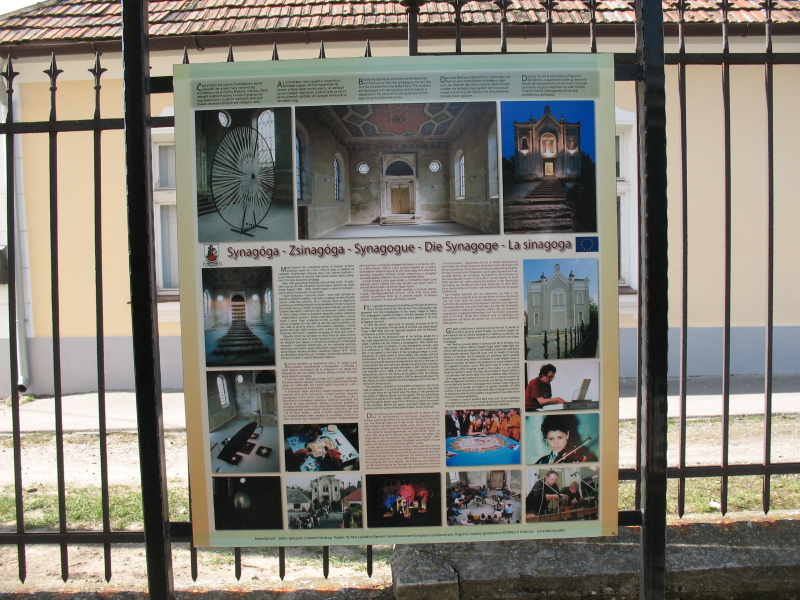
One was the former synagogue in Samorin, a small town southeast of Bratislava, built in 1912.
Back in the early 1990s, it was a derelict shell standing silent and empty on the outskirts of the shabby city center. Its lonely position and crumbling façade underscored its poignancy as a surviving relic of the devastated past.
Since then, it has undergone a dramatic transformation.
Owned by the Union of Slovak Jewish Communities, it is now held on a long-term lease by a couple who took over the building in 1995, restored it and transformed it into the At Home Gallery, a center for contemporary art.
The synagogue is used for cultural purposes aimed at the public at large. It even once hosted the Dalai Lama.
It also now forms part of a new tourism and educational trail called the Slovak Route of Jewish Heritage, which links about 20 historic Jewish sites around the country.
In restoring the building, Csaba Kiss and his Canadian-born wife, Suzanne, deliberately chose to retain evidence that the interior had been desecrated. The walls still bear painted decoration, but the paintings are faded and patchy; they have not been retouched or prettied up.
"Our idea was not to touch the walls," Kiss once told me. "They have memories; we can see them. It's special."
At the seminar's conclusion, participants agreed on a set of pragmatic guidelines with best-practice principles and procedures for the Jewish properties.
Jewish heritage, the guidelines state, "is the legacy of all aspects of Jewish history – religious and secular." At the same time, "Jewish history and art are part of every nation’s history and art. Jewish heritage is part of national heritage, too."
These assertions may appear to state the obvious, but given contentious internal Jewish politics and the taboos and prejudice that historically applied to Jewish culture in Europe, they actually articulate crucial basic concepts. And the guidelines as a whole, while non-binding, represent a milestone when it comes to restituted Jewish properties.
Addressing a frequently heard criticism of Jewish communal management style, the guidelines state, "Honesty and transparency are Jewish values and should be especially apparent in the handling of all matters concerning Jewish property." The guidelines urge detailed documentation of Jewish communal properties and heritage sites and underscore the need for openness and collaboration among Jewish and non-Jewish institutions.
Will these guidelines be followed? Probably not to the letter. Financial considerations, legal obstacles, local conditions and human nature, among other things, prevent adherence to ideals.
Still, they form a framework that can influence practice and, perhaps, finally bring these sites the maintenance and preservation they – and the Jewish people – need.


 Posts
Posts


