Showing posts with label centropa. Show all posts

Friday, July 16, 2010

Centropa -- Travel Column on Vienna

Here's my centropa.org travel column on Vienna.

Vienna 
by Ruth Ellen Gruber 
Vienna looms large in Jewish history and memory. 
The imperial Habsburg capital was the vibrant hub of a vast, multi-national Empire that stretched across Europe and encompassed a colorful and sometimes contentious mix of peoples, languages, religions and local cultures.
Jews lived here for centuries. Surviving pendulum-swing periods of tragedy and triumph, prosperity and persecution, they made key contributions to the cultural, economic and intellectual development of the city.
Nineteenth and early 20th century Vienna in particular was home to some of Europe's most influential artists, authors, musicians and thinkers -- from the writers Joseph Roth, Arthur Schnitzler and Stephan Zweig, to the composers Arnold Schoenberg and Gustav Mahler, to the father of psychoanalysis, Sigmund Freud. Vienna was also the cradle of some of the icons of popular culture: the filmmaker Billy Wilder grew up in the city, and the novelist Vicki Baum, the author of Grand Hotel and other best-sellers, was born here and wrote about her Viennese childhood in her memoirs. "To be a Jew is a destiny," she once said.
The Holocaust swept this world away. But monuments, museums and other vestiges of this long and creative Jewish presence can be found in many parts of the city. What's more, Vienna is home, now, too, to a new flowering of Jewish life and creativity, both religious and secular. Vibrant schools, synagogues and other Jewish centers bear living witness to a remarkable Jewish rebirth in the decades since the Shoah. And Jewish writers, artists, musicians and filmmakers are putting their stamp on contemporary culture.
Visitors to Vienna can get a taste of both worlds. Most Jewish historical sites and monuments, as well as most active synagogues and Jewish centers, are located in central parts of the city, embedded in a historic urban setting that conjures up the grandeur of the past amid the contemporary bustle of modern-day life.
The following itinerary highlights some of the most important (and most easily visited) Jewish sights, but still, alas, gives only a brief taste of the richness of Jewish experience in the city.
The Jewish Museum
Vienna's Jewish Museum is a good place to start for both an overview of the city's Jewish history and a taste of today's Jewish cultural offerings. The Museum's main location opened in 1993 in the Palais Eskeles, a downtown mansion at Dorotheergasse 11, in the heart of Vienna's First District. Its unusual exhibition arrangement offers a unique view of Jewish history and memory.
On the ground floor there a display of Judaica objects from a noted collection is paired with an artistic installation reflecting Viennese Jewish history by the American artist Nancy Spero. Upstairs, there is another display of Judaica -- in what is called the "Viewable Storage Area." Here, massed together on shelves, are hundreds and hundreds of ritual and every day objects, many of them salvaged from destroyed households, synagogues and prayer rooms. Some of the silver objects are charred and smoke-stained from the fires of Kristallnacht. The intent of showing the objects this way is to underscore the pride and prosperity of the Jewish community, as well as the extent of the destruction.
The permanent historical exhibition is something quite different. It comprises no physical objects at all. Instead, it consists of 21 holograms, arranged in a bare room. Each is a sort of holographic still life that represents a specific stage, facet or theme associated with Austrian Jewish history and the relationship between Jews and Austrian society. These themes include "Houses of God," "Zionism," "Anti-Semitism," "Loyalty and Patriotism," "From Historism to Modernism," "Shoah," "Vienna Today Š", "Banishments" and "Fin de Siecle."
Key components of the museum are also a comfortable cafe -- reminis cent of the coffee houses where Jewish writers, intellectuals and luftmenschen alike once passed long hours -- and a well-stocked bookstore featuring hundreds of titles of Jewish interest or by Jewish authors on a wide range of topics.
The Jewish Museum also has a branch at Judenplatz, the heart of Vienna's medieval Jewish quarter, which forms part of a complex inaugurated in 2000 that also includes a Holocaust memorial commemorating the 65,000 Austrian Jews killed in the Shoah and a Holocaust documentation center.
Vienna's flourishing medieval Jewish community was snuffed out in 1420/21 by persecutions that culminated in expulsions, murders and the torching of the synagogue on Judenplatz, with Jews inside. A 15th century plaque in Latin on the house at Judenplatz 2 still celebrates this, reading, in part: "Thus arose in 1421 the flames of hatred throughout the city and expiated the horrible crimes of the Hebrew dogs."
The underground remains of the synagogue were discovered during excavations in the 1990s and these now form the core of the Judenplatz Jewish museum, along with a multi-media exhibit about Medieval Jewish life.
Above, at ground level, stands the Holocaust Monument, a massive cube of reinforced concrete that dominates the square. Called the Nameless Library, it was designed by the British sculptor Rachel Whiteread and takes the form of an "inside-out" library -- rows of books with their spines facing inwards. Also inscribed are the names of the sites where Austrian Jews were killed.
Not far away, near the Opera House, stands a big Monument against War and Fascism, by the artist Alfred Hrdlicka. Among several big symbolic sculptures it incorporates a bronze sculpture of a bearded Jew on his knees, almost prostrate, covered by barbed wire, forced to scrub the street. And as you walk about parts of the city, keep an eye out for the Stolpersteine, or stumbling blocks -- these are brass cobblestones put down to mark the houses where Jews and others killed by the Nazis once lived, as part of a commemorative  project by the artist Gunter Demnig.

What is today Vienna's Second District, across the Danube Canal from the inner city, was long a Jewish neighborhood. Before World War II about 60,000 Jews -- one-third of Vienna's Jewish population -- lived here, and the district was home to so many synagogues, Jewish theaters, schools and other Jewish institutions, that it was dubbed "The Matzo Island." Most of these sites no longer exist, but a number of plaques AND STOLPERSTEINE, OR COMMEMORATIVE STUMBLING BLOCKS, evoke the neighborhood's Jewish history, and new synagogues and other institutions make it a center of Jewish life.

The Main Synagogue

The Stadttempel, Vienna's Main Synagogue, is located on sloping Seitenstettengasse. Designed by the architect Josef Kornhausel, it was built in 1824-26. From the outside, it looks like a plain, anonymous building -- in fact, many synagogues in Europe were hidden behind featureless outer walls. This was either for protection or in compliance with edicts that allowed direct access to the street only for churches. This in act saved the synagogue during Kristallnacht pogrom in November 1938; it was not torched for fear that the entire block could go up in flames. All of the other nearly 100 synagogues and Jewish prayer houses in Vienna were either destroyed or severely damaged. What sets the synagogue apart these days are the armed guards outside.
Inside, the a graceful oval sanctuary is encircled by two tiers of women's galleries and topped by a sky-blue domed ceiling sprinkled with gilded stars. A gilded sunburst surmounts tablets of the Ten Commandments above the ark. At Jewish holidays, every seat is full, and the building complex also houses the Jewish communal offices and archives.
Cemeteries and other sights

What is today Vienna's Second District, across the Danube Canal from the inner city, was long a Jewish neighborhood. Before World War II about 60,000 Jews -- one-third of Vienna's Jewish population -- lived here, and the district was home to so many synagogues, Jewish theaters, schools and other Jewish institutions, that it was dubbed "The Matzo Island." Most of these sites no longer exist, but a number of plaques evoke the neighborhood's Jewish history, and new synagogues and other institutions make it a center of Jewish life.
Vienna has several Jewish cemeteries that are worth exploring, both for their historical importance and for the artistic beauty of the tombs.
The vast Zentralfriedhof or Central Cemetery, at Simmeringer Hauptstrasse 234 in the 11th district, was consecrated in the 1870s and has an extensive Jewish section where about 100,000 people are buried. There are many stately tombs and mausolea, testifying to the prosperity of the community.
One of the easiest cemeteries to visit -- and also one of the most fascinating -- is the Rossau cemetery, the oldest preserved Jewish cemetery in Vienna. It is entered by walking straight through the lobby of a modern municipal old age home at Seegasse 9, in Vienna's 9th district, a five minute walk from the Rossauerlaende U-Bahn stop. (It may seem a cruel juxtaposition to enter a cemetery through an old-age home, but from 1698 to 1934 this was the site of a Jewish hospital.)
The Rossau cemetery is believed to have been founded in 1540 -- the oldest legible stone dates from 1582 -- and it operated until 1783, when the Emperor Joseph II issued a decree banning burials inside what today is the "Gurtel" ring around inner Vienna. Many 17th and 18th century luminaries were buried here, including the financiers Samuel Oppenheimer and Samson Wertheimer.
According to the useful guidebook Jewish Vienna published in 2004 by Mandelbaum Verlag, some of the few local Jews still living in Vienna in 1943 managed to rescue some of the tombstones, either burying them on the spot or transporting them to the Central Cemetery and burying them there.
In the mid-1980s, after the discovery of these stones, the cemetery underwent a full restoration -- and the surviving stones were set up in their original places thanks to a map of the cemetery that had been made in 1912. Many of the stones are massive and feature elegant calligraphy, lengthy epitaphs and some vivid carving of Jewish symbols and floral and other decoration, similar to that on tombs in the Jewish cemetery in Mikulov, Czech Republic, and elsewhere in Moravia. Fragments that could not be put together were used to construct a memorial wall, similar to those that exist in other countries at restored cemeteries. Wertheimer's tomb, a white mausoleum with carved end pieces, is the cemetery's most imposing.
The Rossau Cemetery is a short walk from the Sigmund Freud Museum, at Berggasse 19, which occupies the building where Freud lived and worked from 1891 until 1938, when he fled to England to escape the Nazis. The museum includes original furnishings, some of Freud's antiquities collection and library, films and other material that provide insights into his life and work. The museum also houses a collection of contemporary art and a research library.

Centropa -- Travel Column on Prague

 Old-New synagogue. Photo (c) Ruth Ellen Gruber

Here below is my column on Jewish Prague for centropa.org.

I've been writing about Jewish Prague for, yipes, decades....my first experience there dates back to (yipes again) 1966, when I spent the summer in then-Czechoslovakia with my family. My dad had brought a group of students over from the U.S. and was leading the first American archeological dig in CZ since before WW2. They were digging out in Bylany, a village near Kutna Hora, and one of my brothers stayed there and worked with the crew.

In 2007, soon after my mother's death, I took Dad to revisit the site in Bylany -- I reconnected in 1989 with the archeologists we had known in '66 and we remain close.

In 1966, my mother and youngest brother and I stayed in Prague. Sam and I wandered around the city, visiting the tourist sites and just soaking in the atmosphere, and it is this experience that gave me my deep interest and connection with eastern and central Europe. It was then, indeed, that I had my first contact with Europe's "imaginary wild west" -- when Sam and I attended a 10 a.m. showing in the Kino Sevastopol of Old Shatterhand, one of the movies based on the Karl  May characters.  I fell  in love (like many girls in central Europe at the time) with Pierre Brice, the French actor who played the Apache chieftain Winnetou... I bought postcards of him and also cut out his picture from magazines. I also got a crush on the singer Waldemar Matuska, who performed, among other things, American folk songs in Czech and starred in a Czech language production of Rose-marie (he played the Mountie, the role playedin the movie  by Nelson Eddy, my mother's childhood fave). Matuska, who died last year -- and whom I met at a Czech country festival in 2004 --also had a role in the great Czech Western spoof Lemonade Joe.


While in Prague we visited at least some of the Jewish sites -- and my mother, the artist Shirley Moskowitz, painted a wonderful picture (later developed into a print) of the Old Jewish Cemetery.

(c) estate of Shirley Moskowitz


Here's the centropa article. It picks up on the idea of Jewish Prague as a series of concentric circles that I wrote about at length in my 1994 book Upon the Doorposts of Thy House: Jewish Life in East-Central Europe, Yesterday and Today.

Prague
by Ruth Ellen Gruber
PRAGUE -- Lying between the Vltava River and the Old Town Square, Prague's medieval "Jewish Town," Josefov, is one of the most popular attractions in a magical "golden city" that draws millions of tourists a year. Here, amid historic synagogues, the Old Jewish Cemetery, the Jewish Town Hall and other major sights, is the Ground Zero of Jewish Prague: the stomping ground for heroes and villains and the evocative background setting for a host of old legends, not to mention the cradle of present-day Jewish life. Here, Jewish heritage and legacy are cultivated and exploited as an integral part of the ancient city. At peak season, tourists swarm through the district, making it sometimes difficult to navigate the cobbled streets, and souvenir hawkers sell everything from miniature golems to embroidered kippot.
I imagine the Jewish presence in Prague as a series of concentric circles centered on this medieval ghetto area and then expanding outward, like widening ripples of water, to the edge of the city and beyond. Physical sites, as well as Jewish memory and contemporary Jewish life, are concentrated in the innermost circle: there are a Jewish education center, kosher facilities and Jewish communal offices, and regular services take place in several venues. But there are many places of Jewish interest well away from the city center, too. These are much less visible and well off the beaten track of most visitors to the city, but they, too, form an integral part of the Jewish experience in Prague. The following itinerary will let you sample some of these outer circles of Jewish history and culture as well as the city's inner core.
The Inner Circle
Tourists aside, Prague's old Jewish quarter today bears very little resemblance to the dense welter of narrow alleys, tiny squares, dark passageways and crowded courtyards where generations of Jews were compelled to live from the Middle Ages to the mid-19th century, when the Habsburg monarchs granted them civil rights. After emancipation, many Jews moved out, and Jewish Town became a slum. An urban renewal project in the late 19th century swept away almost everything but a handful of synagogues and a few other historic sites, and the medieval ghetto was replaced by the handsome complex of buildings we see today. On the façade of the building at Maiselova 12, across from the Old-New Synagogue, you can see Jews symbolized by the star of David, money and stereotype profiles.
Jewish Town is still, though, where the city's main Jewish sights are concentrated. And if you can brave the crowds, you will see some of the finest and best preserved and presented Jewish heritage sites in Europe.
These include the 13th-century Old-New (or Alt-neu) Synagogue, the oldest synagogue in Europe still in use. Built about 1270, the compact Gothic building has a high peaked roof and distinctive brick gables. The twin-naved sanctuary features soaring Gothic vaulting and a central bimah enclosed by a late Gothic iron grille. Carvings of grape vines surround the Ark.
Across narrow Cervena alley is the High Synagogue, built in 1568, which, like the Old-New Synagogue, is today an active house of prayer and study. Right next door to the High Synagogue is the Jewish Town Hall (entrance at Maiselova 18), which still serves as the headquarters for Jewish community offices and activities. Built in the 1560s, the Jewish Town Hall is one of the landmarks of the Jewish quarter, with a distinctive tower and big clock with Hebrew letters, that seems to run backwards.
Prague's Jewish Museum occupies several historic synagogue buildings in the district. The museum was originally founded in 1906 to preserve items from the synagogues that were demolished in the urban renewal clearance of the old ghetto. Most of its collections, however, come from the more than 150 provincial Jewish communities in Bohemia and Moravia that were destroyed by the Nazis. The Nazis brought the loot to Prague, and even during World War II used the empty synagogues to exhibit precious relics of the people they sought to annihilate. The museum was run by the communist state after World War II, but it was returned to Jewish administration in 1994.


Today, the collections are displayed thematically in some of the historic synagogues, and these synagogues themselves form key components of the museum complex.
The Maisel Synagogue (Maiselova 10), originally built in 1590, houses an exhibition on Czech Jewish history from medieval times until the end of the 18th century. Among its displays are stunning silver ritual objects. The Spanish synagogue (entrance from Vezenska street), was built in elaborate Moorish style in 1868 on the site where Prague's oldest synagogue once stood. It houses the second part of the Jewish Museum's historical exhibition, detailing the Jewish experience in Prague from the late 18th century to the present. Next door, the Robert Guttman Gallery hosts temporary exhibitions, mainly of contemporary art. The Museum's "Jewish Customs and Traditions" exhibition is housed in the Baroque Klausen synagogue (U Stareho Hrbitova 1), built in the late 17th century. The Pinkas Synagogue (Siroka 3), built in 1535 as a private prayer house for the wealthy Horowitz family, is a memorial to the Jews from Bohemia and Moravia who were killed in the Holocaust. The names and dates of birth and death of all 77,297 victims are inscribed on the walls of the sanctuary. Its upper floor houses an exhibit of materials from the Holocaust period, in particular from the Terezin ghetto, including drawings and poems by the children there.
The unforgettable Old Jewish Cemetery (entrance from the Pinkas synagogue courtyard) is also part of the Museum. Here, some 12,000 tombstones crowd together in bristling clusters, tilted crazily and sunk into the earth. Founded at the beginning of the 15th century, the cemetery was in use until 1787: Lack of space caused graves to be placed on top of each other, and the cemetery's unique appearance has inspired artists and poets for centuries. The oldest identified gravestone is that of Avigdor Kara, from 1439. The Old Cemetery's Ceremonial Hall (U Stareho Hrbitova 3), built in 1911-1912, houses an exhibition on Jewish funeral practices.


Many famous Prague Jews are buried in the Old Jewish Cemetery, including the 16th-century financier Mordechai Maisel and the legendary Rabbi Judah ben Bezalel (c. 1525-1609), a scholar and educator known as the Maharal ("most venerated teacher and rabbi"). Rabbi Loew's tomb is a place of pilgrimage, where pious Jews and tourists alike leave prayers and supplications written on slips of paper.


Many legends grew up around Rabbi Loew over the centuries -- the most famous has it that he created the Golem -- an artificial man made of clay and magically brought to life to protect the Jews. The Rabbi and the legends about him became so deeply rooted in Prague folk culture that a statue of him was included as part of the decoration of the New Town Hall that was built in 1910.


The author Franz Kafka (1883-1924) is also intimately connected with Prague's Jewish Town. He was born on the edge of the Jewish quarter and spent much of his life in and around the district. There is an extensive Franz Kafka Museum at the Hergetova Cihelna, on the Malá Strana bank of the Vltava, as well as a small exhibit at U Radnice 5 (or, Franz Kafka Square), near the Old Town Square, on the site where Kafka was born. A bust of the author stares out from the street corner there, and, not far away, a monument to Kafka stands next to the Spanish Synagogue. This is a 12-foot sculpture that shows a tiny figure of Kafka perched atop an empty suit of men's clothing that seems to be walking. Kafka himself is buried in Prague's New Jewish Cemetery.
Just outside the Jewish Quarter, one of the sculptures that line the tourist-choked Charles Bridge across the Vltava River is a big figure of the crucified Jesus with gold letters spelling out the Hebrew words Kadosh, Kadosh, Kadosh Adonai Tzvaot (Holy, Holy, Holy Is the Lord of Hosts) affixed above it. In the 17th century, the Jewish community was forced to pay for these words to be placed on the cross as punishment for the alleged desecration of the crucifix by a Jew.

Outer Circles
The lavishly ornate Jubilee Synagogue, located at Jeruzalemska street 7 near Wenceslas Square, was designed by the prolific architect Wilhelm Stiassny and built to replace three synagogues destroyed in the clearance of the old ghetto. It is still used for services. Formally called the Emperor Franz Joseph Jubilee synagogue, it was named in honor of the Habsburg ruler and officially dedicated in 1908 -- the 60th anniversary of his reign. Franz Joseph was a respected, even beloved, figure among Jews -- it was during his reign that Jews were granted full emancipation -- and even today there is a portrait of him hanging in the function room of the Jewish Town Hall. The Jubilee Synagogue incorporates Moorish, Byzantine and art nouveau elements, with a striped façade, towers, arches and a rose window incorporating a star of David.
Several other synagogues still stand in Prague, too. Among them is the stark-looking synagogue in the Smichov district, at the corner of Plzenska and Stroupeznickeho streets, which was built in 1863 and totally remodeled in the Functionalist style in 1931. It now serves as the archive of the Jewish Museum. The neo-Romanesque Liben Synagogue, at the Palmovka metro station, was built in 1860 to replace an earlier synagogue, built in the 16th century. After World War II it was used as a warehouse, but it was restored in the 1990s and now serves as a venue for cultural events. In the outlying suburb of Michle, the synagogue (on u Michelskeho Mlyna street) now serves as a church.


There are several Jewish cemeteries in outer parts of Prague. Two of them are particularly significant and easily visited.
The New Jewish Cemetery, located at the Zelivskeho metro stop in eastern Prague, was founded in 1890 next to the city's main Olsany cemetery complex, and is still in use. The wealth and importance of the Jewish community in the late 19th and early 20th century can be seen in the ornate ceremonial hall and the many imposing family tombs and other monuments. A white, crystal-shaped stone marks Franz Kafka's grave, and a plaque there commemorates Kafka's three sisters, who were killed in the Holocaust.


The Jewish Cemetery in Zizkov, not far from the New Cemetery, near the Jiri z Podebrad metro stop, now forms part of the Jewish Museum. Opened in 1680 as a graveyard for Jewish victims of the plague, it was the main Jewish burial place in Prague between the closure of the Old Cemetery in 1787 and the opening of the New Cemetery. Most of the cemetery was demolished in the 1950s, and a huge, futuristic-looking television tower was erected on the site in the 1980s: a number of sculptures of crawling babies were placed on the structure about ten years ago and add to its weirdness. The surviving section of the cemetery is fenced off and is only open limited times during the week, but it can easily be viewed from outside. It includes the imposing tombs of important personalities, including the influential Prague Chief Rabbi Ezekiel Landau (1713-1793).
There is also a walled-off Jewish cemetery in the Liben district, between Na Malem Klinu and Strelnicni streets, as well as an 18th-century Jewish cemetery in Urhineves, an outlying suburb in southeast Prague. Located at the end of Vachkova street, it was cleaned up and restored in the mid-2000s.

Thursday, April 1, 2010

Latest Centropa column -- Budapest

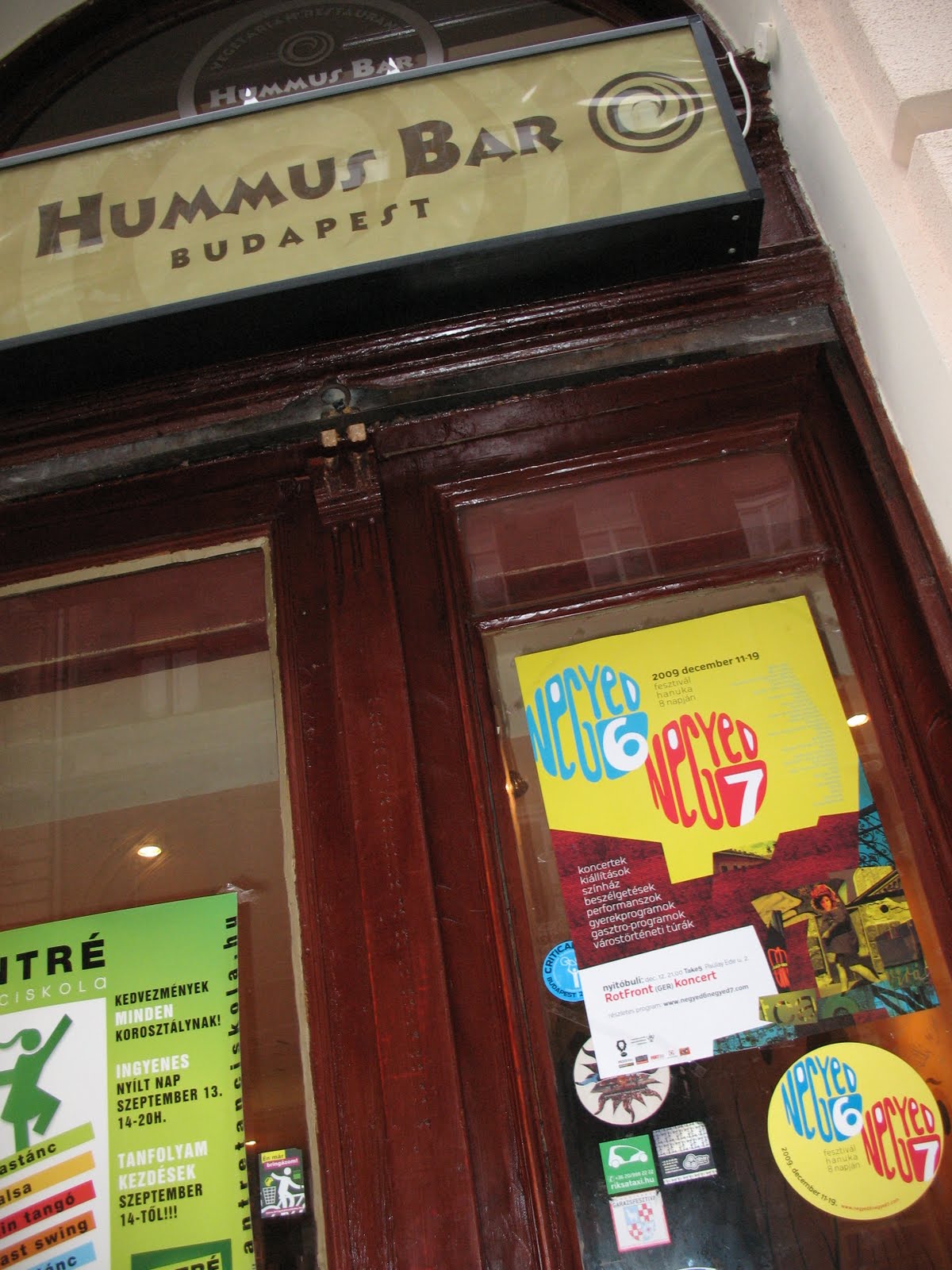
 The Hummus bar on Kertesz utca. Photo (c) Ruth Ellen Gruber


My latest travel column for Centropa.org is a guide to some of the cafes and restaurants I like to hang out in  in Budapest's old downtown Jewish quarter.

Budapest's Seventh District Wakes Up
By Ruth Ellen Gruber


BUDAPEST -- The last time I wrote about Budapest on Centropa I provided an itinerary of Jewish sights and resources, most of them in and around the city's Seventh District, the old downtown Jewish quarter anchored by three grand synagogues forming a so-called "Jewish triangle." 
That was eight years ago, and the former Jewish quarter still had the reputation of being one of the city's poorest inner districts. There were some signs of incipient gentrification, but World War II bullet holes pocked many crumbling facades, vacant lots yawned, and the grimy streets were dark and uninviting. A lot has changed since then.
Much of the District is still neglected. But already at the end of 2007 the New York Times ran a travel story called "Out of Darkness, New Life" that described how the district's "history and recent rise to trendiness" evoke "comparisons to the Lower East Side of New York." A recent issue of Time Out Budapest magazine went even further, terming the Jewish quarter a major city "bar vortex." In fact, the district burgeons with new cafes, clubs, bistros and wine bars that attract a young, hip -- and often Jewish -- crowd.
At the same time, though, this type of growth has been paralleled by controversial urban renewal projects that have seen many old buildings torn down and replaced by rather soulless modern structures.  A citizens group, OVAS, has been formed to lobby for the protection of what remains -- particularly in light of real estate corruption involved in some of the development schemes. The Mayor of the Seventh District himself, in fact, was jailed last year on suspicion of bribery and abuse of office related to property transactions.
I've maintained a small apartment in the Seventh District for more than a decade. Though I only spend part of my time here, I've been observing the changes in the quarter up close; after all, it's my neighborhood.
In particular, I enjoy the new venues and Jewish haunts that have nothing to do with a nostalgic sense of a vanished past but everything to do with how Jews in Budapest -- and particularly young Jews in Budapest -- are experimenting with ways to build a lively present and, one hopes, a sustainable future.
With this article, I would like to introduce readers to some of the haunts in and around the Jewish quarter that I tend to frequent: whether for breakfast cappuccino or afternoon espresso, for an inexpensive lunch, or for dinner or late night drinks and conversation. Or simply as somewhere to sit and use the free WiFi internet that most venues in the district seem to offer.
As I noted in my earlier Centropa article on Budapest, the Seventh District was the first and most important Jewish quarter in Pest, the flat part of Budapest that spreads out on the eastern bank of the Danube.
Today's downtown Deak Square and the massive red brick Madach apartment complex occupy the site of Orczy House, a vast structure built in the 1700s that was a central focus of Jewish life in Budapest throughout the 19th century.  Orczy House was demolished as part of an urban renewal project in the 1930s. Before that, it served as a self-contained warren of synagogues, study houses, apartments, baths, restaurants, cafes, shops, warehouses, and workshops: the place where many Jews from the provinces first found a home when they moved into the big city.
The broader Jewish quarter eventually spread out from here, with Kiraly street, at the edge of the Seventh, becoming its major commercial avenue, a heavily trafficked thoroughfare lined by many fine neoclassical buildings.  The back streets branching off Kiraly street into the Seventh comprised a dense network of shops, artisans' workshops, and tenements built around connecting courtyards encircled by balconies and tiny flats. At the heart of the district was what is now called Klauzal square, an open space fronting one of the city's district market halls that became the center of the World War II ghetto.
The three main synagogues that form the "Jewish Triangle" are all in the inner part of the district -- the twin-towered Dohany St. synagogue and the orthodox synagogue complex on Kazinczy street, both in use and both fully restored and refurbished in recent years, and the Moorish-style synagogue on Rumbach street, which still stands disused and in disrepair, after restoration was halted for lack of funds.
Most of the cafes and other venues I mention are within a ten-minute walk of these synagogues, and are also close to two synagogues run by Chabad, one on Deak square and one on Vasvary Pal street.
These are only a few of the many cafes and restaurants in the district -- but they tend to be the one that I (and my friends) frequent.
          Read Full Article

Friday, August 21, 2009

Bielsko-Biala -- My latest Centropa column

Jewish-style restaurant in Bielsko-Biala. Photo (c) Ruth Ellen Gruber

Here's a link to my latest column for Centropa.org, on Bielsko-Biala, Poland.

BIELSKO BIALA

Published Aug. 20, 2009

Before visiting Bielsko-Biala in southern Poland, I went online to check hotels. One of them, I found, was offering what it called a "Jewish Heritage Package."

Terrific, I thought. I was going to Bielsko-Biala for something else -- an international performance art festival. But I knew the town is rich in Jewish history, and I was looking forward to exploring it in more detail. Then I clicked the link and saw the itinerary.


Read full story