Showing posts with label Slovakia. Show all posts

Wednesday, July 4, 2012

Ruthless Cosmopolitan: Jewish Heritage in Slovakia


RUTHLESS COSMOPOLITAN: In Slovakia, Being Strategic About Preserving Jewish Heritage

August 28, 2011

By Ruth Ellen Gruber

BRATISLAVA, Slovakia (JTA) -- In 1989, on the eve of the fall of communism, the American poet Jerome Rothenberg published a powerful series of poems called "Khurbn" that dealt with the impact of the Holocaust on Eastern Europe.

In one section, he recorded conversations he had had in Poland with local people who had little recollection of the flourishing pre-war Jewish presence.

"Were there once Jews here?" the poem goes. "Yes, they told us, yes they were sure there were, though there was no one here who could remember. What was a Jew like? they asked.

"No one is certain still if they exist."

I often think of this poem when I travel to far-flung places in Eastern and Central Europe, and it was certainly on my mind on a trip to Slovakia this August.


That's because yes, there are still Jews here, and the post-Communist revival has reinvigorated Jewish communities in the region.


But also, despite this, numbers are still so small that even in many places where Jews once made up large parts of the population, Jewish history and heritage have been, or run the risk of being, forgotten.


"Look," my friend Maros Borsky reminded me in Bratislava. "Kids who were born after 1989 don't even remember communism."

Borsky is trying to do something about this -- which is why I was in Slovakia.


The vice president of the Bratislava Jewish community, Borsky is also Slovakia's leading Jewish scholar and expert on Slovak Jewish heritage.
 At 37 he is the leading Slovak Jewish activist of his generation, engaged in everything from religious, cultural and educational initiatives to his own personal commitment to raising his daughters in a Jewish home.

"I'll do anything to support his efforts, he has made such a difference to Jewish life here," said Andrew Goldstein, a British Reform rabbi who has played a hands-on role in nurturing Jewish revival in the Czech Republic and Slovakia for more than two decades.

Now chairman of the European Union for Progressive Judaism, Goldstein comes to Bratislava once a month to hold classes and lead a non-Orthodox Shabbat service as an alternative to the one conducted by the city's only resident rabbi, Baruch Myers, who is affiliated with Chabad.


Goldstein and I met in Bratislava nearly six years ago when he officiated at Borsky's wedding.
 This time, Goldstein and his wife and I, along with half a dozen Israeli journalists, were on a five-day tour that Borsky led to Jewish communities and heritage sites around the country.


The aim was to introduce the Slovak Jewish Heritage Route, an educational and touristic itinerary Borsky devised as a means of integrating Jewish heritage and memory into local tourism, culture and education so that Jews, their history and their fate are not forgotten.


I have followed the development of the route ever since Borsky first conceived it five years ago, and I believe it is an important strategic endeavor that could provide a model for other countries. Only 3,000 Jews live in Slovakia today, but there are synagogue buildings or Jewish cemeteries in literally hundreds of towns and even major cities. The Slovak Jewish community does not have the resources to save or even to care for all these places.

So Borsky convinced communal leaders to sanction a strategy that concentrates on just a few. This resulted in his Slovak Jewish Heritage Route, which includes 24 flagship sites in all eight regions of the country: mainly synagogues, but also Jewish cemeteries, Holocaust memorials and museums. They are marked with plaques bearing a distinctive logo.

Each was chosen for its historic or architectural significance but also for its sustainability. This does not mean, of course, that other sites should be forgotten. But to be included on the route, there must be a partnership in place with a local body to ensure long-term care and maintenance.

Our tour took in more than a dozen of the sites: from the active synagogue in Bratislava to Presov in the far east, where the magnificence of the surviving synagogue utterly dwarfs the potential of a Jewish community that now numbers only a few dozen people. We saw synagogues used as art galleries, and one now used as an art school. There were little Jewish exhibits, and ruined synagogues still undergoing repair. In one of these, the partially ruined synagogue in Liptovsky Mikulas, Goldstein and his wife stopped to chant prayers so that the sounds of Jewish liturgy could once again be heard.

Tuesday, June 9, 2009

My lated Moked comment -- Samorin, Slovakia

My latest Moked piece -- from May. The Wounded Synagogue


La sinagoga ferita

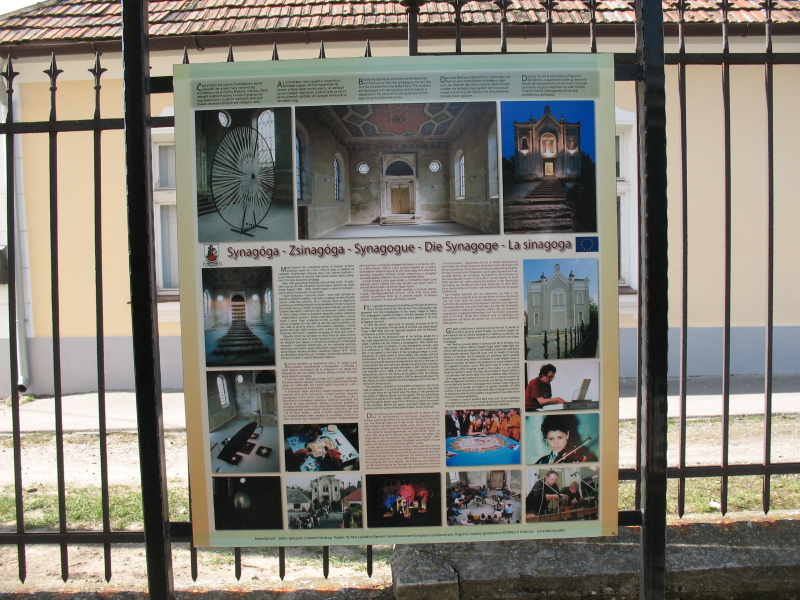
La storia rivelata in un cartellone. A Samorin, una piccola città slovacca vicino a Bratislava, un manifesto permanente narra in cinque lingue, compreso l’italiano, il modo in cui la sinagoga locale è stata riportata in vita dopo mezzo secolo di abbandono. La sinagoga era stata costruita nel 1912. Durante la Seconda Guerra Mondiale gli ebrei che vivevano lì furono sterminati. La sinagoga fu utilizzata come un deposito di munizioni, poi come magazzino di grano. La prima volta che l’ho vista, nel 1990, il suo stato di degrado e solitudine mi ha toccato veramente il cuore. Pochi anni dopo, una coppia canadese di origini slovacche e’ riuscita a salvarla. Rivolgendosi all’Unione ebraica di Bratislava, Suzanne e Csaba Kiss hanno preso in affitto la sinagoga e l’hanno trasformata in un centro per l’arte contemporanea. L’hanno chiamata la “At Home Gallery” — “La Galleria di casa.” Nessun ebreo vive più nel luogo. Ma la gente torna, ebrei e non ebrei, per assistere ai concerti, alle mostre e alle altre manifestazioni culturali. Lo stesso Dalai Lama è stato un ospite alcuni anni fa. Durante il restauro della sinagoga, i Kiss hanno preso una decisione importante. Hanno ripristinato perfettamente la facciata, ma dentro, invece, hanno lasciato tracce molto suggestive che testimoniano del danno e del degrado subito. “Le tramandano ricordi,” dice Csaba Kiss. “Li vediamo. E’ molto speciale.” Questa storia si legge sul cartellone che accoglie i visitatori.

Friday, March 27, 2009

RUTHLESS COSMOPOLITAN -- Jewish Heritage

Samorin synagogue, At H0me Gallery, 2009. Photo (c) Ruth Ellen Gruber

My latest Ruthless Cosmopolitan column is from the milestone Bratislava seminar on the care, conservation and maintenance of historic Jewish property.

March 26, 2009

By Ruth Ellen Gruber

BRATISLAVA, Slovakia (JTA) – The restitution of Jewish communal property in Central and Eastern Europe has been a hot-button issue since the Iron Curtain fell nearly 20 years ago.

But often forgotten amid the slow and painful legal battles to get back historic Jewish properties that were seized by the Nazis or nationalized by postwar Communist regimes is the practical and urgent need to care for, conserve and maintain the properties once they’ve been recovered.

For two decades and more, I've documented, written about and photographed these sites, which include many yeshivas and synagogues.

Many are huge. Many are dilapidated. Some are recognized as historic monuments. Most stand in towns where few, if any, Jews now live. Even basic maintenance can stretch already strapped communal resources.

In March, I joined Jewish community representatives from 15 countries who gathered to address these concerns at a seminar held in the Slovak capital, Bratislava.

The aim of the meeting was to foster networking and cross-border consultation and spark creative strategic thinking. Many participants had never met before and had little awareness of how colleagues in other countries were confronting similar challenges. Some knew little about the variety of Jewish heritage sites in other countries.

The meeting dealt with issues ranging from fundraising to roof repair to what Jewish law says about synagogue re-use.

During the seminar, which was organized by the American Jewish Joint Distribution Committee, the International Survey of Jewish Monuments and the Slovak Jewish Heritage Center, we visited several sites in the Bratislava area to see how some best-practice solutions had been implemented.

One was the former synagogue in Samorin, a small town southeast of Bratislava, built in 1912.

Back in the early 1990s, it was a derelict shell standing silent and empty on the outskirts of the shabby city center. Its lonely position and crumbling façade underscored its poignancy as a surviving relic of the devastated past.

Since then, it has undergone a dramatic transformation.

Owned by the Union of Slovak Jewish Communities, it is now held on a long-term lease by a couple who took over the building in 1995, restored it and transformed it into the At Home Gallery, a center for contemporary art.

The synagogue is used for cultural purposes aimed at the public at large. It even once hosted the Dalai Lama.

It also now forms part of a new tourism and educational trail called the Slovak Route of Jewish Heritage, which links about 20 historic Jewish sites around the country.

In restoring the building, Csaba Kiss and his Canadian-born wife, Suzanne, deliberately chose to retain evidence that the interior had been desecrated. The walls still bear painted decoration, but the paintings are faded and patchy; they have not been retouched or prettied up.

"Our idea was not to touch the walls," Kiss once told me. "They have memories; we can see them. It's special."

At the seminar's conclusion, participants agreed on a set of pragmatic guidelines with best-practice principles and procedures for the Jewish properties.

Jewish heritage, the guidelines state, "is the legacy of all aspects of Jewish history – religious and secular." At the same time, "Jewish history and art are part of every nation’s history and art. Jewish heritage is part of national heritage, too."

These assertions may appear to state the obvious, but given contentious internal Jewish politics and the taboos and prejudice that historically applied to Jewish culture in Europe, they actually articulate crucial basic concepts. And the guidelines as a whole, while non-binding, represent a milestone when it comes to restituted Jewish properties.

Addressing a frequently heard criticism of Jewish communal management style, the guidelines state, "Honesty and transparency are Jewish values and should be especially apparent in the handling of all matters concerning Jewish property." The guidelines urge detailed documentation of Jewish communal properties and heritage sites and underscore the need for openness and collaboration among Jewish and non-Jewish institutions.

Will these guidelines be followed? Probably not to the letter. Financial considerations, legal obstacles, local conditions and human nature, among other things, prevent adherence to ideals.

Still, they form a framework that can influence practice and, perhaps, finally bring these sites the maintenance and preservation they – and the Jewish people – need.