Showing posts with label shirley moskowitz. Show all posts

Friday, September 24, 2010

Article -- Calabrian village honors Philadelphia artist

 I have an article in the Philadelphia Jewish Exponent about the opening of the permanent exhibition of my mother's art work in Nocara, Calabria.

Italian Village Honors Work of Philly Artist

September 23, 2010

Ruth Ellen Gruber
Jewish Exponent Feature
NOCARA, Italy
 
Shirley Moskowitz
During the 1970s and '80s, my parents spent considerable chunks of time in southern Italy, documenting local life in Nocara, a wind-swept Calabrian village that clings to the crest of a half-mile-high hill overlooking the Gulf of Taranto.
My father, Jacob W. Gruber, was an anthropologist at Temple University, and was there to carry out an ethnographic study. He visited peasant homes and observed local events, interviewed and photographed people, and took reams of notes about local customs, traditions and beliefs.
My mother, the artist Shirley Moskowitz, recorded village life her own way.
Setting up her easel in odd corners of the town, she painted dozens of landscapes, townscapes and portraits that keenly captured both the harshness of the sunbaked uplands and the living face of a village that was just emerging from an age-old traditional lifestyle into modernity.

My mother died in 2007.
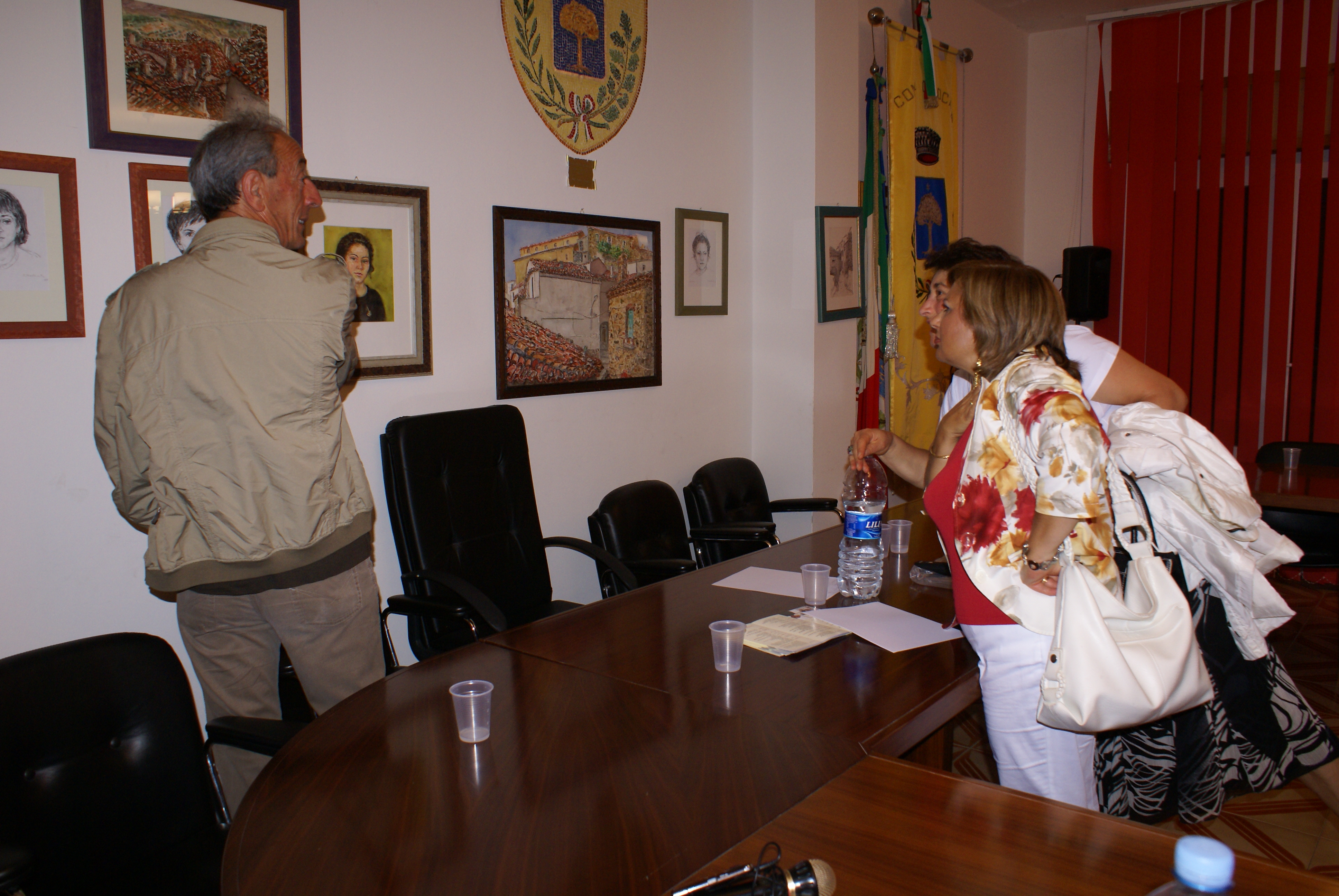
This past August, on what would have been her 90th birthday, Nocara honored her memory and her creativity by opening a permanent exhibit of some 40 of her artworks in the main chamber of the local town hall.
My father, who is now 89, and my brother, Sam, flew to Italy, and together we drove eight hours south from my home in Umbria to be guests of honor at the opening ceremony.
As we walked through Nocara's narrow streets, Dad was accosted by villagers who remembered "il professore" and my mother from the old days. Some of them now are middle-aged adults whose likenesses my mother had drawn when they were children.
Many angles of town leaped out at us as if from one of Mom's paintings: a rough stone archway, the flat face of a chapel in its little piazza, steep stone lanes and tiled roofs.
Much has changed, of course. Pigs no longer graze in Nocara's streets, as I recall seeing them do when I visited my parents there decades ago. And donkeys are no longer a major means of transport. Moreover, Nocara now has gas, running water and other modern utilities, including Internet access.
A Posthumous Thanks 
"Shirley Moskowitz's paintings represent a piece of Nocara, at a special time in its history," Mayor Franco Trebisacce told the several dozen people who attended the ceremony. "We have an obligation to display them here, and to offer our posthumous thanks to an artist who loved this town, and to her family."
Synagogue collage by artist Shirley Moskowitz
The exhibit, in fact, was a long time coming.
My parents had donated Mom's art works to Nocara a decade ago.
The gift had made headlines in local newspapers at the time, but the works were never permanently displayed, and for the past eight years or so they had languished in storage, almost forgotten.
Mayor Trebisacce, who came to office last year, remembered them, however, and became curious about their fate. Earlier this summer, he and his aides found them in a closet, packed away in their original shipping case.
A Google search took them to the Web site that my family had created about my mother's art after her death -- shirleymoskowitz.wordpress.com -- and they contacted us by leaving a comment on the site.
Many of the works that Mom donated to Nocara had already been exhibited at several major shows in Philadelphia, including a landmark retrospective at the University of the Arts in 1996 that had showcased more than half-a-century of my mother's life in art.
Her work encompassed a variety of media -- from simple line drawings and sketches to sculpture, oils and the joyously complex, multilayered collages that, since the 1960s, had become her signature style.
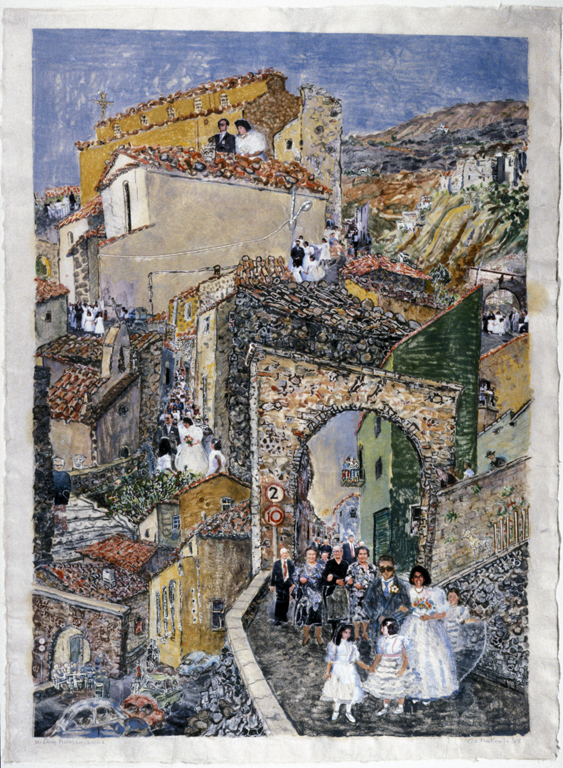
Some of her paintings and drawings now on display in Nocara, in fact, formed the basis of several of her major collages, such as "Wedding Procession," dating from 1988.
Looking back, Mom was an intensely Jewish artist, but not a "Jewish artist," per se.
She never created Jewish ritual art, though she frequently turned to Jewish themes and subject matter.
One of her first sculptures, dating from 1942, is a study of a huddled man and woman called "Refugees," and other sculptures, prints and paintings depict a cantor, a rabbi, Jewish holidays and life-cycle events, even a solemn moment from the Aleinu prayer.
A collage she created as a sort of multi-textured self-portrait prominently included Shabbat candlesticks, even though she herself was not observant.
And following a trip she took with me in Eastern Europe in 1992, she produced a particularly powerful series of monotype prints of some of the ruined synagogues and Jewish cemeteries that we visited.
But these -- like her Judaism itself -- were all part of the much broader kaleidoscope of her life. Her work, in fact, embraced and reflected the wide variety of landscapes, friends, family and experiences that made up her world.
Her collages in particular mixed dreams and reality to project a richly textured vision of life as she lived and perceived it, among her family, friends, neighbors and the local environment.
As she once put it, they were based "on personal experience and are composed to affect the viewer from a distance while at the same time inviting him to participate in the action -- to experience through color, dynamic contrasts of light and dark, and various techniques, a reality that may seem fantastic but is still real."

Sunday, August 8, 2010

Symposium and Exhibit in Nocara, Calabria

Here's a crosspost from the Shirley Moskowitz web site -- a brief report on the symposium and opening of a permanent exhibit of my mother's art work in the remte village of Nocara, Calabria, last week. You can see other posts at the web site.


Nocara — Exhibit Opening and Conference

The event in Nocara August 4 opening the permanent exhibit of works that Shirley Moskowitz did there in the 1970s and 1980s and donated to the village 10 years ago was a great success – and lots of fun. The art works — townscapes, landscapes and portraits, mainly in watercolor, ink or pencil — are hung in the Town Council meeting room, and this, says Mayor Franco Trebisacce, is where they will remain, as a testament to the history of the village at a time when it was just on the verge of change from the age-old traditional lifestyle to modernity.

The speakers — two professors from the University of Cosenza and Vincenzo Salerno, the former longtime mayor of Nocara — discussed both the context of the works as well as the development of the village and the importance of the collection, and what it represents, for the town. Salerno recalled that Mom and Dad visited Nocara for lengthy periods of time over several years, at various seasons of the year. He noted that back then, it was still a largely peasant society, where donkeys were used for transport and animals were kept in town. Few men under retirement age lived in town, as most had immigrated northward to find work. Sam then spoke about the art itself. And we were presented with an engraved plaque as thanks for Mom’s work.

Dad gave a very moving little speech about Mom and her life as an artist — I recorded it and will try to post as an mp3.


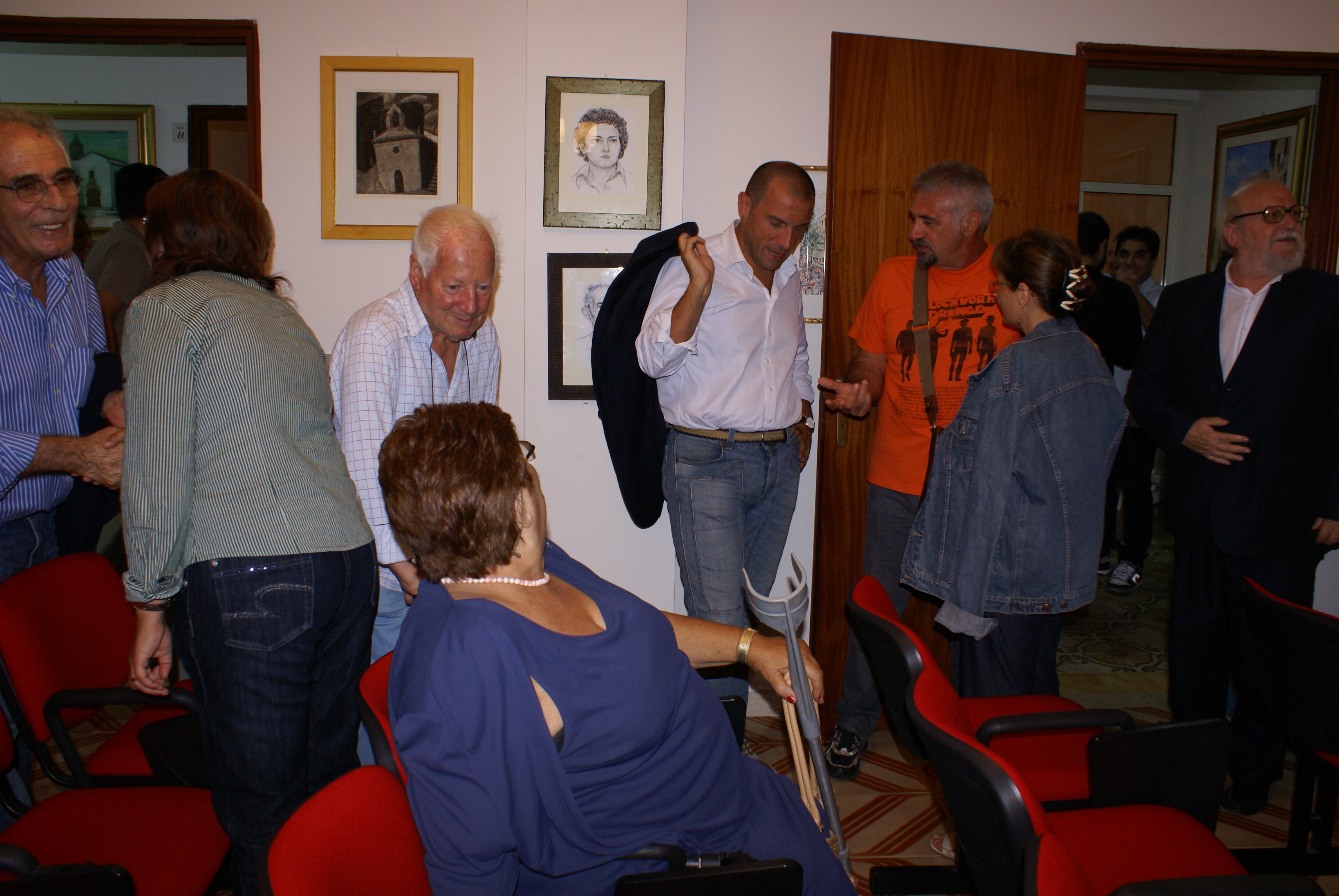
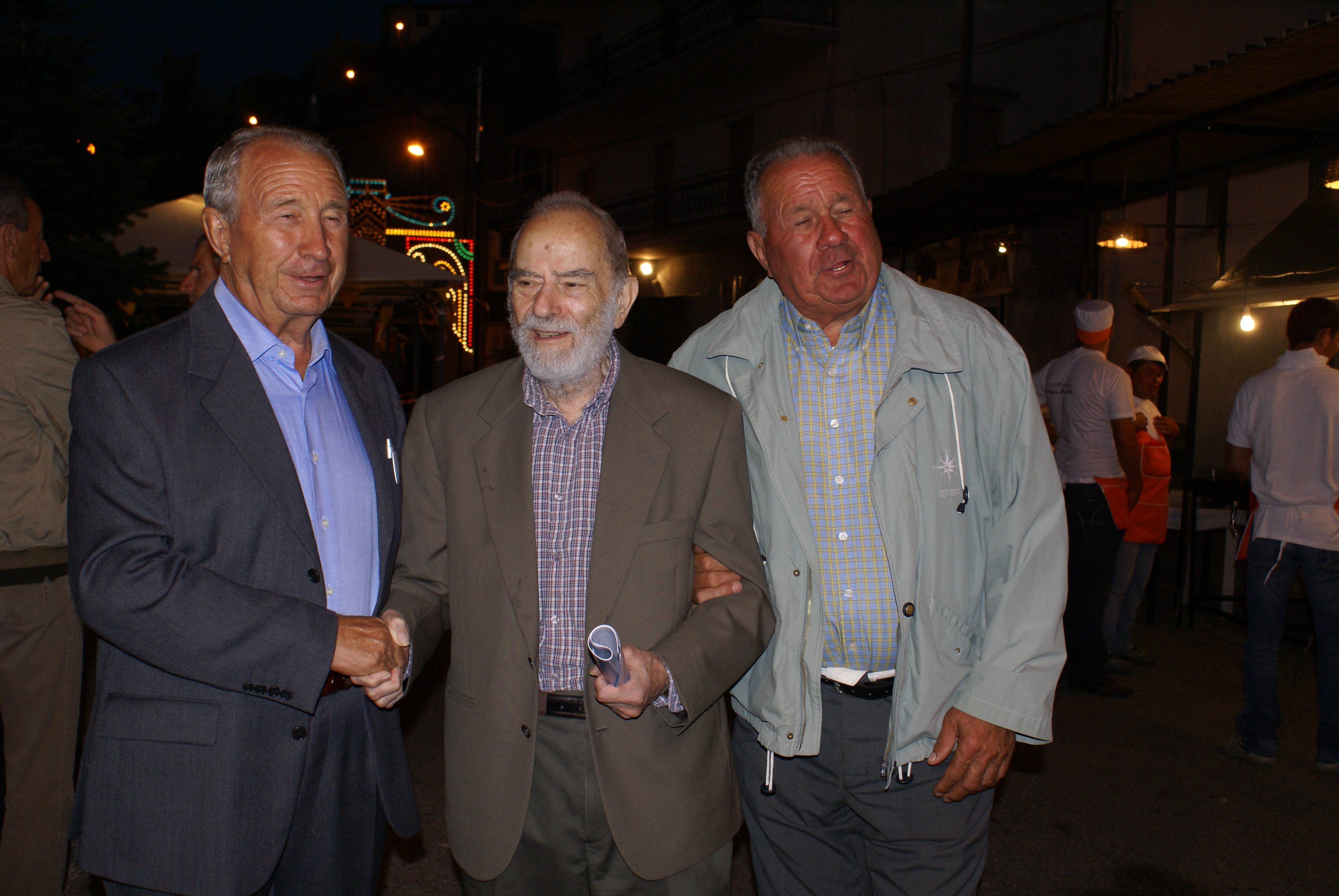
There was an enthusiastic turnout, including a number of people who remembered Mom and Dad from the old days. Many people came up to Dad to reminisce — and Dad’s Italian rose to the occasion. The few people I knew from my own two visits to Nocara many years ago were there — and even to me recognizable, including Vincenzo Salerno, his brother Cici, and Giuseppe and Maria De Mateo.
Vincenzo Salerno, Dad, Cici Salerno
There were several people in attendance who now, as adults, were able to see the portraits Mom did of them as children. Few of these people still live in Nocara (though some were back for  summer vacation). Ernesto (shown here) is one of the few younger people who still lives in the town. We kept hearing over and over that Nocara is now was just “a town of old people.”
Ernesto, then and now
The event kicked off the annual summer pork festival (Festa del Maiale) — and the evening concluded amid an outdoor grilled feast,  loud music, and dancing in the piazza. (Including with Cici Salerno — with whom I remember dancing in the piazza in 1981!)
Mayor Trebisacce


The festival culminates with a big religious procession of the Madonna on August 15, either to or from the old monastery chapel of Santa Maria degli Antropici way down a very winding road from the village.
Nocara on top of its hill
Shepherd and his dog and Vespa outside the monastery

Monday, July 19, 2010

Conference on Shirley Moskowitz's art in Calabria

I'll be going to Calabria in a couple of weeks, with my dad and my brother Sam, for a conference on the art work my mother did in the small village of Nocara in the 1970s and 80s.

Here's a cross post from the shirleymoskowitz.wordpress.com web site --


Arch in Nocara, 1982. Intaglio

A conference on the art work that Shirley Moskowitz did in the 1970s and early 1980s in the small town of Nocara, in Calabria, will be held in Nocara on August 4 — which would be Shirley’s 90th birthday. It is being organized by the Mayor of Nocara and the local authorities.
I don’t have all the details yet, but it will be a one-day event, that afternoon/evening, with a speaker from the University of Cosenza.
Shirley spent several periods of time painting in Nocara, while her husband, Jake, was there carrying out ethnographic work.


She mainly did drawings and water color townscapes as well as a series of portraits of local people.


Some of these works, as well as the photographs she took, formed the basis of later prints and major collages, such as Processione (1987/88), based on a procession of the Madonna she had photographed.


Wedding Procession (Nocara), 1988

An exhibition of Shirley’s work from Nocara was held in the village in the early 1980s. Some years ago, she donated many of the art works she had created there to the town, where they are displayed in the local museum.

Friday, July 16, 2010

Centropa -- Travel Column on Prague

 Old-New synagogue. Photo (c) Ruth Ellen Gruber

Here below is my column on Jewish Prague for centropa.org.

I've been writing about Jewish Prague for, yipes, decades....my first experience there dates back to (yipes again) 1966, when I spent the summer in then-Czechoslovakia with my family. My dad had brought a group of students over from the U.S. and was leading the first American archeological dig in CZ since before WW2. They were digging out in Bylany, a village near Kutna Hora, and one of my brothers stayed there and worked with the crew.

In 2007, soon after my mother's death, I took Dad to revisit the site in Bylany -- I reconnected in 1989 with the archeologists we had known in '66 and we remain close.

In 1966, my mother and youngest brother and I stayed in Prague. Sam and I wandered around the city, visiting the tourist sites and just soaking in the atmosphere, and it is this experience that gave me my deep interest and connection with eastern and central Europe. It was then, indeed, that I had my first contact with Europe's "imaginary wild west" -- when Sam and I attended a 10 a.m. showing in the Kino Sevastopol of Old Shatterhand, one of the movies based on the Karl  May characters.  I fell  in love (like many girls in central Europe at the time) with Pierre Brice, the French actor who played the Apache chieftain Winnetou... I bought postcards of him and also cut out his picture from magazines. I also got a crush on the singer Waldemar Matuska, who performed, among other things, American folk songs in Czech and starred in a Czech language production of Rose-marie (he played the Mountie, the role playedin the movie  by Nelson Eddy, my mother's childhood fave). Matuska, who died last year -- and whom I met at a Czech country festival in 2004 --also had a role in the great Czech Western spoof Lemonade Joe.


While in Prague we visited at least some of the Jewish sites -- and my mother, the artist Shirley Moskowitz, painted a wonderful picture (later developed into a print) of the Old Jewish Cemetery.

(c) estate of Shirley Moskowitz


Here's the centropa article. It picks up on the idea of Jewish Prague as a series of concentric circles that I wrote about at length in my 1994 book Upon the Doorposts of Thy House: Jewish Life in East-Central Europe, Yesterday and Today.

Prague
by Ruth Ellen Gruber
PRAGUE -- Lying between the Vltava River and the Old Town Square, Prague's medieval "Jewish Town," Josefov, is one of the most popular attractions in a magical "golden city" that draws millions of tourists a year. Here, amid historic synagogues, the Old Jewish Cemetery, the Jewish Town Hall and other major sights, is the Ground Zero of Jewish Prague: the stomping ground for heroes and villains and the evocative background setting for a host of old legends, not to mention the cradle of present-day Jewish life. Here, Jewish heritage and legacy are cultivated and exploited as an integral part of the ancient city. At peak season, tourists swarm through the district, making it sometimes difficult to navigate the cobbled streets, and souvenir hawkers sell everything from miniature golems to embroidered kippot.
I imagine the Jewish presence in Prague as a series of concentric circles centered on this medieval ghetto area and then expanding outward, like widening ripples of water, to the edge of the city and beyond. Physical sites, as well as Jewish memory and contemporary Jewish life, are concentrated in the innermost circle: there are a Jewish education center, kosher facilities and Jewish communal offices, and regular services take place in several venues. But there are many places of Jewish interest well away from the city center, too. These are much less visible and well off the beaten track of most visitors to the city, but they, too, form an integral part of the Jewish experience in Prague. The following itinerary will let you sample some of these outer circles of Jewish history and culture as well as the city's inner core.
The Inner Circle
Tourists aside, Prague's old Jewish quarter today bears very little resemblance to the dense welter of narrow alleys, tiny squares, dark passageways and crowded courtyards where generations of Jews were compelled to live from the Middle Ages to the mid-19th century, when the Habsburg monarchs granted them civil rights. After emancipation, many Jews moved out, and Jewish Town became a slum. An urban renewal project in the late 19th century swept away almost everything but a handful of synagogues and a few other historic sites, and the medieval ghetto was replaced by the handsome complex of buildings we see today. On the façade of the building at Maiselova 12, across from the Old-New Synagogue, you can see Jews symbolized by the star of David, money and stereotype profiles.
Jewish Town is still, though, where the city's main Jewish sights are concentrated. And if you can brave the crowds, you will see some of the finest and best preserved and presented Jewish heritage sites in Europe.
These include the 13th-century Old-New (or Alt-neu) Synagogue, the oldest synagogue in Europe still in use. Built about 1270, the compact Gothic building has a high peaked roof and distinctive brick gables. The twin-naved sanctuary features soaring Gothic vaulting and a central bimah enclosed by a late Gothic iron grille. Carvings of grape vines surround the Ark.
Across narrow Cervena alley is the High Synagogue, built in 1568, which, like the Old-New Synagogue, is today an active house of prayer and study. Right next door to the High Synagogue is the Jewish Town Hall (entrance at Maiselova 18), which still serves as the headquarters for Jewish community offices and activities. Built in the 1560s, the Jewish Town Hall is one of the landmarks of the Jewish quarter, with a distinctive tower and big clock with Hebrew letters, that seems to run backwards.
Prague's Jewish Museum occupies several historic synagogue buildings in the district. The museum was originally founded in 1906 to preserve items from the synagogues that were demolished in the urban renewal clearance of the old ghetto. Most of its collections, however, come from the more than 150 provincial Jewish communities in Bohemia and Moravia that were destroyed by the Nazis. The Nazis brought the loot to Prague, and even during World War II used the empty synagogues to exhibit precious relics of the people they sought to annihilate. The museum was run by the communist state after World War II, but it was returned to Jewish administration in 1994.


Today, the collections are displayed thematically in some of the historic synagogues, and these synagogues themselves form key components of the museum complex.
The Maisel Synagogue (Maiselova 10), originally built in 1590, houses an exhibition on Czech Jewish history from medieval times until the end of the 18th century. Among its displays are stunning silver ritual objects. The Spanish synagogue (entrance from Vezenska street), was built in elaborate Moorish style in 1868 on the site where Prague's oldest synagogue once stood. It houses the second part of the Jewish Museum's historical exhibition, detailing the Jewish experience in Prague from the late 18th century to the present. Next door, the Robert Guttman Gallery hosts temporary exhibitions, mainly of contemporary art. The Museum's "Jewish Customs and Traditions" exhibition is housed in the Baroque Klausen synagogue (U Stareho Hrbitova 1), built in the late 17th century. The Pinkas Synagogue (Siroka 3), built in 1535 as a private prayer house for the wealthy Horowitz family, is a memorial to the Jews from Bohemia and Moravia who were killed in the Holocaust. The names and dates of birth and death of all 77,297 victims are inscribed on the walls of the sanctuary. Its upper floor houses an exhibit of materials from the Holocaust period, in particular from the Terezin ghetto, including drawings and poems by the children there.
The unforgettable Old Jewish Cemetery (entrance from the Pinkas synagogue courtyard) is also part of the Museum. Here, some 12,000 tombstones crowd together in bristling clusters, tilted crazily and sunk into the earth. Founded at the beginning of the 15th century, the cemetery was in use until 1787: Lack of space caused graves to be placed on top of each other, and the cemetery's unique appearance has inspired artists and poets for centuries. The oldest identified gravestone is that of Avigdor Kara, from 1439. The Old Cemetery's Ceremonial Hall (U Stareho Hrbitova 3), built in 1911-1912, houses an exhibition on Jewish funeral practices.


Many famous Prague Jews are buried in the Old Jewish Cemetery, including the 16th-century financier Mordechai Maisel and the legendary Rabbi Judah ben Bezalel (c. 1525-1609), a scholar and educator known as the Maharal ("most venerated teacher and rabbi"). Rabbi Loew's tomb is a place of pilgrimage, where pious Jews and tourists alike leave prayers and supplications written on slips of paper.


Many legends grew up around Rabbi Loew over the centuries -- the most famous has it that he created the Golem -- an artificial man made of clay and magically brought to life to protect the Jews. The Rabbi and the legends about him became so deeply rooted in Prague folk culture that a statue of him was included as part of the decoration of the New Town Hall that was built in 1910.


The author Franz Kafka (1883-1924) is also intimately connected with Prague's Jewish Town. He was born on the edge of the Jewish quarter and spent much of his life in and around the district. There is an extensive Franz Kafka Museum at the Hergetova Cihelna, on the Malá Strana bank of the Vltava, as well as a small exhibit at U Radnice 5 (or, Franz Kafka Square), near the Old Town Square, on the site where Kafka was born. A bust of the author stares out from the street corner there, and, not far away, a monument to Kafka stands next to the Spanish Synagogue. This is a 12-foot sculpture that shows a tiny figure of Kafka perched atop an empty suit of men's clothing that seems to be walking. Kafka himself is buried in Prague's New Jewish Cemetery.
Just outside the Jewish Quarter, one of the sculptures that line the tourist-choked Charles Bridge across the Vltava River is a big figure of the crucified Jesus with gold letters spelling out the Hebrew words Kadosh, Kadosh, Kadosh Adonai Tzvaot (Holy, Holy, Holy Is the Lord of Hosts) affixed above it. In the 17th century, the Jewish community was forced to pay for these words to be placed on the cross as punishment for the alleged desecration of the crucifix by a Jew.

Outer Circles
The lavishly ornate Jubilee Synagogue, located at Jeruzalemska street 7 near Wenceslas Square, was designed by the prolific architect Wilhelm Stiassny and built to replace three synagogues destroyed in the clearance of the old ghetto. It is still used for services. Formally called the Emperor Franz Joseph Jubilee synagogue, it was named in honor of the Habsburg ruler and officially dedicated in 1908 -- the 60th anniversary of his reign. Franz Joseph was a respected, even beloved, figure among Jews -- it was during his reign that Jews were granted full emancipation -- and even today there is a portrait of him hanging in the function room of the Jewish Town Hall. The Jubilee Synagogue incorporates Moorish, Byzantine and art nouveau elements, with a striped façade, towers, arches and a rose window incorporating a star of David.
Several other synagogues still stand in Prague, too. Among them is the stark-looking synagogue in the Smichov district, at the corner of Plzenska and Stroupeznickeho streets, which was built in 1863 and totally remodeled in the Functionalist style in 1931. It now serves as the archive of the Jewish Museum. The neo-Romanesque Liben Synagogue, at the Palmovka metro station, was built in 1860 to replace an earlier synagogue, built in the 16th century. After World War II it was used as a warehouse, but it was restored in the 1990s and now serves as a venue for cultural events. In the outlying suburb of Michle, the synagogue (on u Michelskeho Mlyna street) now serves as a church.


There are several Jewish cemeteries in outer parts of Prague. Two of them are particularly significant and easily visited.
The New Jewish Cemetery, located at the Zelivskeho metro stop in eastern Prague, was founded in 1890 next to the city's main Olsany cemetery complex, and is still in use. The wealth and importance of the Jewish community in the late 19th and early 20th century can be seen in the ornate ceremonial hall and the many imposing family tombs and other monuments. A white, crystal-shaped stone marks Franz Kafka's grave, and a plaque there commemorates Kafka's three sisters, who were killed in the Holocaust.


The Jewish Cemetery in Zizkov, not far from the New Cemetery, near the Jiri z Podebrad metro stop, now forms part of the Jewish Museum. Opened in 1680 as a graveyard for Jewish victims of the plague, it was the main Jewish burial place in Prague between the closure of the Old Cemetery in 1787 and the opening of the New Cemetery. Most of the cemetery was demolished in the 1950s, and a huge, futuristic-looking television tower was erected on the site in the 1980s: a number of sculptures of crawling babies were placed on the structure about ten years ago and add to its weirdness. The surviving section of the cemetery is fenced off and is only open limited times during the week, but it can easily be viewed from outside. It includes the imposing tombs of important personalities, including the influential Prague Chief Rabbi Ezekiel Landau (1713-1793).
There is also a walled-off Jewish cemetery in the Liben district, between Na Malem Klinu and Strelnicni streets, as well as an 18th-century Jewish cemetery in Urhineves, an outlying suburb in southeast Prague. Located at the end of Vachkova street, it was cleaned up and restored in the mid-2000s.

Monday, April 20, 2009

RUTHLESS COSMOPOLITAN -- Online Epitaph

My latest Ruthless Cosmopolitan column describes the web site we have created to honor my mother, the artist Shirley Moskowitz Gruber, and in doing so post an online epitaph.


In the piazza, Morruzze.


April 17, 2009

By Ruth Ellen Gruber

ROME (JTA) -- One year ago I joined my father, my brothers and their families, as well as a few other friends and relatives, at my mother's grave in Santa Monica, Calif.

It was close to the first anniversary of Mom's death, and we gathered with a rabbi for a ceremony to unveil her headstone.

Mom is buried in a municipal cemetery shaded by palm trees. Like most of the other grave markers there, a simple, flat plaque rather than a standing tombstone denotes her resting place.

All that is written about her is her name and the years of her birth and death. And there's a menorah, following the tradition of marking Jewish women's graves with depictions of candlesticks.

But there is no epitaph. Nothing that tells about who she was, where she came from, how she lived or the way she was regarded.

The fifth commandment enjoins us to honor our fathers and mothers.

This year, as the second anniversary of Mom's death approached, my brothers and I joined the growing ranks of children who now choose to honor their parents online, creating a Web site to celebrate our mother's life and commemorate her. Also, since my mother was an artist, we wanted to share images and information about her work.

Essentially what we did with the Web site was to etch an epitaph for Mom in cyberspace, picking up on an age-old tradition of personifying the deceased through words chiseled into solid stone.

My brothers and I all collected material and supplied content, but I was the one who designed the site, sticking to several basic priorities.

For one, the software had to be easy to use. We had to be able to post both text and photos. Since we wanted to encourage response and interaction, we also needed a format that combined a Web site with a blog.

The Web sites built by friends of mine for their parents run the gamut from simple memorials aimed primarily at family and close friends to elaborate multimedia constructions or sites aimed at placing a personal life story into the context of broader history.

The Web site for Lore Rasmussen, who died in January, details her life as a Jewish refugee from Nazi Germany who went on to become an American civil rights activist and educator. The site that artist Josh Gosfield put up to honor his father, Gene, includes animation and a jivey rap poem.

"In the two minutes that it takes from beginning to end, I recall his life -- that which I know only through stories, that which I experienced firsthand, and that which I imagined," Josh told me.

I considered various formats, but in the end I chose a simple wordpress.com blog template. It's not overly ambitious, but it's straightforward -- as was my mother -- and so far it seems to fit the bill.

People already have begun to find it.

"I was so happy to come across this website. Your parents were very important to me when I was a young child," reads our first post, a moving tribute from a woman who knew my folks 25 years ago.

"I am so glad that you started this website," she added, "if only for the opportunity that it gave me to reflect on what your mother and father meant to me."

In my work over the past two decades, I've visited hundreds of Jewish cemeteries where lives and life stories endure in sculpted form, sometimes for centuries.

Some epitaphs use stock phrases and pious platitudes. But some tombstones bear elaborate carvings, with symbols denoting the name, heritage, attributes or profession of the deceased. Others feature epitaphs that read like full-blown CVs -- birth place, death place, education, professional positions, honors, titles, family.

Sometimes I get a chill when I read these persisting evocations of rich and complex lives.

Because of the Holocaust, most of the the people buried in Jewish cemeteries in Central Europe have left no direct descendants. The cemeteries themselves often are overgrown and abandoned. Still, here are the declarations of love and bereavement, of honor and respect.

For example, I never knew my great-grandmother, Ettel Gruber. She was the mother of my father's father, and I was given my middle name in her honor. Ettel died in Romania, well up in her 90s, in 1947, having survived the Holocaust.

Prewar pictures show her with a stern-looking visage. But her epitaph calls her "a positive and dedicated woman, fair and kind in all her doing; (she) offered hospitality and charity to the poor and set a full table for the Tzaddikim."

Cyberspace is not stone, and I have no idea how long the online epitaphs we are creating with our Web sites will endure.

I do know, however, that if you Google my mother's name, you'll find her. And if you follow the link, you'll get to know something about who she was and why we still care so much about her.

The Web site for my mother, Shirley Moskowitz Gruber, is at shirleymoskowitz.wordpress.com.

(Ruth Ellen Gruber's books include "National Geographic Jewish Heritage Travel: A Guide to Eastern Europe," "Letters from Europe (and Elsewhere)," and "Virtually Jewish: Reinventing Jewish Culture in Europe." She blogs on Jewish heritage issues at jewish-heritage-travel.blogspot.com.)

no image specified