Tuesday, June 30, 2009

RUTHLESS COSMOPOLITAN -- Michael Jackson and the Jewish Nose

In Vienna this weekend, I visited the Jewish Museum to see the exhibit "Typisch!" -- about Jewish and other ethnic stereotypes. The exhibition already has shown at the Jewish Museum in Berlin and at the Spertus Museum in Chicago. What should I find as one of the exhibits? Michael Jackson, who else....

So -- here's my latest Ruthless Cosmopolitan column about the experience.....

Poster for Typical!," an exhibit at the Jewish Museum in Vienna that features a photo of Michael Jackson used to illustrate how the singer tried to crush stereotypes. (Ruth Ellen Gruber)

Poster for Typical!," an exhibit at the Jewish Museum in Vienna that features a photo of Michael Jackson used to illustrate how the singer tried to crush stereotypes. (Ruth Ellen Gruber)
Ruthless Cosmopolitan: Michael Jackson and the Jewish nose

By Ruth Ellen Gruber - June 29, 2009

VIENNA (JTA) -- Amid all the noisy outpouring over Michael Jackson's sudden death, the last place I expected to find him was in a Jewish museum. But there he was, his pale, mask-like, surgically engineered image featured as part of an exhibition at the Jewish Museum in the Austrian capital.

Called "Typical! -- Cliches of Jews and Others," the exhibition deals with the use (and abuse) of ethnic stereotypes in popular culture. The exhibition, which runs until October, has been shown at the Jewish Museum in Berlin and the Spertus Museum in Chicago.

It was assembled long before Jackson died June 25 in Los Angeles.

In a life-size photograph from 2002, he is shown with lank black hair framing a long, square stubbly chin, pinched red mouth, huge made-up eyes and a tiny nose with distorted pointy tip.

The photo is used to illustrate how, for better or worse, the King of Pop attempted to destroy stereotypes and, literally, to cut himself away from the confines of physical definition.

Jackson's "surgical transformations mirrored back to the culture the blurring of boundaries demarcating adulthood, sex and even race," Guy Trebay wrote in The New York Times after Jackson's death.

The "Typical!" exhibition deals with stereotypes commonly used to categorize African Americans, Muslims, women, Native Americans and others.

But given that it is mounted at a Jewish museum, much of its focus is on stereotypes about Jews. The exhibition poster employs a few sketched strokes to conjure up some: corkscrew curls, a hat and a huge hooked nose.

Indeed, the multitude of variations on the (alleged) size and shape of the Jewish nose form a major theme.

"The paradigm for the 'typically Jewish' nose originated in the craniological studies of Johann Friedrich Blumenbach," an information panel informs. A German natural scientist who died in 1840, Blumenbach "claimed to have evidence that Jews had an especially prominent nasal bone."

Exhibit installations examine the misuse of this and other paradigms in "scientific" teaching, as well as the ways in which they became part of the vernacular shorthand that shapes the way we see others and ourselves.

A section called "the schnoz," for example, shows a collection of 19th century walking sticks whose handles are formed by exaggerated noses. The contemporary artist Dennis Kardon's installation "Jewish Noses” features dozens of larger-than-life-sized casts made from the noses of actual Jews to demonstrate the silliness of such nasal cliches. Also, a modern painting ironically comments on the love and success that are supposed to result if one has a nose job.

"I am often asked whether or not Jews have a 'Semitic' nose," reads an exhibition quote by the historian Sander Gilman, who has written extensively about Jewish stereotypes. "After 54 years of experience, I can only answer that every Jew I have ever met has a nose."

The inclusion of Jackson's picture in the mix highlighted the transformations his own nose infamously went through.

It also reminded me of a book I read some years ago, a vicious anti-Semitic satire called "The Operated Jew," that was written in 1893 by a German doctor named Oskar Panizza.

An attack on efforts by Jews to assimilate into mainstream society, the book is a creepy and extremely disturbing tale about how a Jew named Itzig Faitel Stern tries to rid himself physically of the stereotypical signs of his Jewishness and become a "modern" European.

Foreshadowing Jackson's experiences under the knife, Stern submits to radical procedures, including the straightening and bleaching of his hair, "Extreme Makeover"-style cosmetic surgery and a series of horrendous operations to straighten his bones. He even gets a full transfusion of "Christian blood."

"It is impossible for me to give the reader an account of all the garnishings, changes, injections and quackeries to which Itzig Faitel Stern submitted himself," the narrator states. "He experienced the most excruciating pain and showed great heroism so he could become the equivalent of an occidental human being."

In the end, it doesn't help. At his wedding to a Christian woman, all falls apart and Stern "reverts" to the ugliest anti-Semitic cliche of the Jew.

Panizza, an early exponent of Nazi-style racial anti-Semitism, set out to "prove" that Jews could never become part of the mainstream modern world, even if they physically attempted to change their skins.

It's not exactly clear what world Jackson was trying to become part of -- or leave -- with his surgeries and other transformations.

Artistically he was the ultimate crossover, winning fans of all colors, ages, religions, nationalities and sexual orientations all around the world. Over the years, though, he alienated some African Americans by his physical manipulation of identity and apparent ambivalence about his own blackness.

Death, though, appears to have brought Jackson back to his roots -- or in any case to a warm embrace by the African-American community.

“We want to celebrate this black man," the actor and singer Jamie Foxx said to cheers at the Black Entertainment Television Music Awards Sunday. "He belongs to us, and we shared him with everybody else.”

Foxx added, "It didn't matter what he looked like, it was all about what he sounded like. It didn't matter what his nose looked like -- I loved the old nose and the new nose."

Read story on JTA

Tuesday, June 9, 2009

My lated Moked comment -- Samorin, Slovakia

My latest Moked piece -- from May. The Wounded Synagogue


La sinagoga ferita

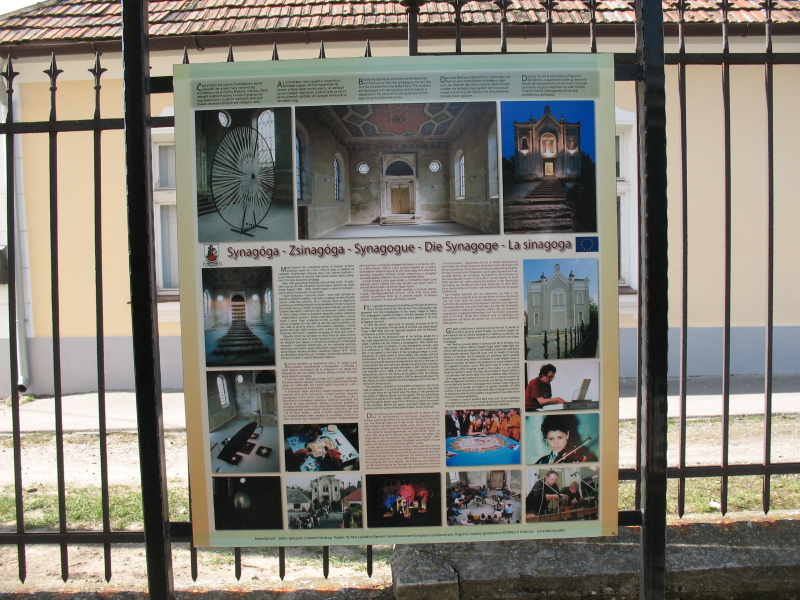
La storia rivelata in un cartellone. A Samorin, una piccola città slovacca vicino a Bratislava, un manifesto permanente narra in cinque lingue, compreso l’italiano, il modo in cui la sinagoga locale è stata riportata in vita dopo mezzo secolo di abbandono. La sinagoga era stata costruita nel 1912. Durante la Seconda Guerra Mondiale gli ebrei che vivevano lì furono sterminati. La sinagoga fu utilizzata come un deposito di munizioni, poi come magazzino di grano. La prima volta che l’ho vista, nel 1990, il suo stato di degrado e solitudine mi ha toccato veramente il cuore. Pochi anni dopo, una coppia canadese di origini slovacche e’ riuscita a salvarla. Rivolgendosi all’Unione ebraica di Bratislava, Suzanne e Csaba Kiss hanno preso in affitto la sinagoga e l’hanno trasformata in un centro per l’arte contemporanea. L’hanno chiamata la “At Home Gallery” — “La Galleria di casa.” Nessun ebreo vive più nel luogo. Ma la gente torna, ebrei e non ebrei, per assistere ai concerti, alle mostre e alle altre manifestazioni culturali. Lo stesso Dalai Lama è stato un ospite alcuni anni fa. Durante il restauro della sinagoga, i Kiss hanno preso una decisione importante. Hanno ripristinato perfettamente la facciata, ma dentro, invece, hanno lasciato tracce molto suggestive che testimoniano del danno e del degrado subito. “Le tramandano ricordi,” dice Csaba Kiss. “Li vediamo. E’ molto speciale.” Questa storia si legge sul cartellone che accoglie i visitatori.

Tuesday, June 2, 2009

RUTHLESS COSMOPOLITAN -- Bielsko Biala

Photo (c) Ruth Ellen Gruber

My latest Ruthless Cosmopolitan column is from Bielsko Biala, Poland, about the impact of perception on memory.

Poland’s Jewish heritage is about more than just death

BIELSKO-BIALA, Poland (JTA) -- Outside the elegant theater in the city of Bielsko Biala in southern Poland, a billboard advertises an upcoming play. Stark letters spell out the title: "Zyd" -- Jew.

The lettering looks almost menacing, like scrawled graffiti, and I am a little taken aback.

But then I remember where I am.

This is Poland.

And the play, in fact, is an award-winning exploration of anti-Semitism and the power of stereotypes -- part of the endless continuing discussion here about the Jewish past, the Jewish present, and the long, complex and troubled relationship between Jews and Catholic Poles.

"There is no theme that Poles are more likely to discuss than Jews," the play's author, Artur Palyga told the Polish media. "It can be said that Judaism is our national passion."

"Zyd" deals with teachers in a provincial Polish town preparing for the visit of a former student, a Holocaust survivor who had attended their school before the Shoah, when Jews made up more than half the town's population.

Its portrayal of grassroots prejudice is graphic and sometimes grotesque. Indeed, the play came under fire in the right-wing press, and its premiere last year sparked protests.

Still, it won the main prize at a national festival of contemporary Polish drama for being "an honest, brave and theatrically precise attempt to settle accounts with the difficult Polish past."

The play is essentially about memory. In particular, it’s about the various uses to which memory is put, and how memory differs in the minds of different people considering the same past.

These issues have suffused much of my own work over the past two decades, as I have researched Jewish heritage sites in East and Central Europe and chronicled the Jewish experience in places were few or no Jews live today.

How are Jews and Jewish heritage remembered? Which Jewish places and personalities are incorporated into the local consciousness? How do local people choose to portray an important part of the population that was savagely removed, almost overnight?

I found Bielko Biala permeated with examples of how perspective influences memory.

They ranged from indifferent disregard to the kitschy commercialization of a "Jewish-style" restaurant called Rabbi, to an earnest attempt to acknowledge the contribution of Jews to the city.

Bielsko Biala was officially established in 1951 with the amalgamation of two towns on opposite sides of the Biala River, which for centuries formed the border between the Austrian Empire and Poland, and then the regions of Silesia and Galicia.

Before 1939, the population was divided among ethnic Germans, Jews and Poles, and the city remains a stronghold of Protestantism. The Nazis absorbed it into the Reich, and almost all the Jews were killed. After World War II, Poland took it over and expelled the ethnic Germans.

Only a small Jewish community lives here today, but Jews played a major role in local history. In the 19th century, Jewish industrialists helped build the city into a major textile center, and a local Jewish architect, Karol Korn, designed key buildings that still define Bielsko Biala.

Korn's grandest building -- the Moorish-style great synagogue -- no longer exists. Erected in 1881, it dominated the city's main avenue until it was blown up by the Nazis in 1939.

Today, a contemporary art gallery occupies the spot; a small plaque on an outer wall commemorates the destroyed building but says nothing about the community it once served.

There's a puppet theatre now next door, where the Jewish culture center once stood, and a courthouse occupies the former Jewish community building across the street. Its elaborate decoration, I was told, represents the seven fruits mentioned in the Torah.

The Jewish cemetery, whose red-and-orange striped ceremonial hall is another Korn design, is well maintained and designated a cultural monument. Among the tombs is a poignant memorial to Jewish soldiers who fell fighting for the Austrians in World War I.

All these sites, and more, are noted on Jewish heritage itineraries included in local guidebooks available at the tourist information office and the city museum. On sale in both places I found reproductions of old postcards portraying the synagogue in all its glory as a major pre-war landmark.

I have no way of knowing who follows these itineraries or purchases the postcards. But, at least for tourists, they clearly acknowledge the Jewish contribution to the town and set Jewish history and heritage here within the general matrix.

This marks a welcome contrast to the "Jewish heritage package" offered by one of the city's leading hotels.

Far from exploring the rich historic contribution of Jews here, its itinerary is simply a round trip to Auschwitz, with "sightseeing" at the memorial museum there, then dinner back at the hotel's restaurant.

Bielsko Biala is only 25 miles from Auschwitz. I would certainly urge anyone visiting the town to take a day and go there. But promoting a tour of the Nazis' most notorious death camp as a Jewish heritage package banalizes Jewish heritage and the Holocaust, and both ignores and insults the memory of the generations of Jews who lived here (and often prospered).

In Bielsko Biala, Poles have begun to offer up a more nuanced take on history -- Jewish and Polish. Unfortunately, however, hotel tourist packages tend to offer only what their clients demand. Jews should take the lead in demanding more.

Even in places where few or no Jews live anymore, Jewish heritage must not be equated with its destruction. Nor, indeed, should the centuries-old Jewish experience be defined solely in terms of death.


Monday, April 20, 2009

My latest Moked comment -- Romania

My latest photo and comment on the Italian web site moked.it harks back to the Passover seder I spent in 1991 in Radauti, Romania, the town from which my grandparents emigrated to the USA.

Passover 1991, Radauti. Photo (c) Ruth Ellen Gruber
Il Seder di Pesach. Una cerimonia antica. Una cerimonia vissuta in famiglia o fra amici, raffigurata qui in una immagine che è abbastanza vecchia, ma, nel mio cuore e nella mia memoria, rimane senza tempo. E' Pesach del 1991, a Radauti, una cittadina nel nord della Romania da dove, un secolo fa, i miei nonni erano emigrati in America. Siamo una ventina di persone, quasi tutti anziani, seduti in una stanza della sinagoga. Fa freddo. Portiamo maglie e capotti. C'è un solo ragazzo, il figlio del presidente della piccolissima comunità, che ha cantato le quattro domande del Ma Nishtanà. Il Seder è finito. Abbiamo mangiato il kugel di matzot, uova sode, manzo stufato con patate. Abbiamo bevuto un vino dolce che viene da Israele. Le fiamme delle candele si spengono. L'uomo che ha condotto il Seder è stanco. Canta con una voce molto debole. E lui è unico fra i presenti che ricorda ancora della mia famiglia. Dopo la cena, cantiamo il tradizionale, Had Gadya. Conosco una melodia. Un amico venuto con me da Bucarest ne propone un'altra. E il vecchio intona, con un filo di voce, un' altra melodia, una melodia molto particolare, che non ho mai sentito. Canta, forse, nel modo in cui cantavano, anni e anni fa, i miei antenati.

Translation:
The Passover Seder. An ancient ceremony. A ceremony observed with family or friends, shown here in an image that is rather old, but, in my heart and memory, remains timeless. It is Pesach 1991, in Radauti, a small town in the north of Romania, from which, a century ago, my grandparents emigrated to America. We are about 20 people, almost all elderly, seated in a room of the synagogue. It is cold. We wear sweaters and coats. There is only one boy, the son of the president of the tiny Jewish community, who chanted the Four Questions. The Seder is over. We ate matzo kugel, hard-boiled eggs, stewed beef with potatoes. We drank sweet wine imported from Israel. The flames of the candles are sputtering out. The man who conducted the Seder is tired. He said with a very weak voice. And he is the only person here who still remembers my family. After the meal, we sing the traditional song, Had Gadya. I know one melody. A friend who came with me from Bucharest knows another. And the old man sings, with a quavering voice another melody, a very particular melody, one that I had never heard before. He sings, perhaps, the way that, years and years ago, my own ancestors sang.

RUTHLESS COSMOPOLITAN -- Online Epitaph

My latest Ruthless Cosmopolitan column describes the web site we have created to honor my mother, the artist Shirley Moskowitz Gruber, and in doing so post an online epitaph.


In the piazza, Morruzze.


April 17, 2009

By Ruth Ellen Gruber

ROME (JTA) -- One year ago I joined my father, my brothers and their families, as well as a few other friends and relatives, at my mother's grave in Santa Monica, Calif.

It was close to the first anniversary of Mom's death, and we gathered with a rabbi for a ceremony to unveil her headstone.

Mom is buried in a municipal cemetery shaded by palm trees. Like most of the other grave markers there, a simple, flat plaque rather than a standing tombstone denotes her resting place.

All that is written about her is her name and the years of her birth and death. And there's a menorah, following the tradition of marking Jewish women's graves with depictions of candlesticks.

But there is no epitaph. Nothing that tells about who she was, where she came from, how she lived or the way she was regarded.

The fifth commandment enjoins us to honor our fathers and mothers.

This year, as the second anniversary of Mom's death approached, my brothers and I joined the growing ranks of children who now choose to honor their parents online, creating a Web site to celebrate our mother's life and commemorate her. Also, since my mother was an artist, we wanted to share images and information about her work.

Essentially what we did with the Web site was to etch an epitaph for Mom in cyberspace, picking up on an age-old tradition of personifying the deceased through words chiseled into solid stone.

My brothers and I all collected material and supplied content, but I was the one who designed the site, sticking to several basic priorities.

For one, the software had to be easy to use. We had to be able to post both text and photos. Since we wanted to encourage response and interaction, we also needed a format that combined a Web site with a blog.

The Web sites built by friends of mine for their parents run the gamut from simple memorials aimed primarily at family and close friends to elaborate multimedia constructions or sites aimed at placing a personal life story into the context of broader history.

The Web site for Lore Rasmussen, who died in January, details her life as a Jewish refugee from Nazi Germany who went on to become an American civil rights activist and educator. The site that artist Josh Gosfield put up to honor his father, Gene, includes animation and a jivey rap poem.

"In the two minutes that it takes from beginning to end, I recall his life -- that which I know only through stories, that which I experienced firsthand, and that which I imagined," Josh told me.

I considered various formats, but in the end I chose a simple wordpress.com blog template. It's not overly ambitious, but it's straightforward -- as was my mother -- and so far it seems to fit the bill.

People already have begun to find it.

"I was so happy to come across this website. Your parents were very important to me when I was a young child," reads our first post, a moving tribute from a woman who knew my folks 25 years ago.

"I am so glad that you started this website," she added, "if only for the opportunity that it gave me to reflect on what your mother and father meant to me."

In my work over the past two decades, I've visited hundreds of Jewish cemeteries where lives and life stories endure in sculpted form, sometimes for centuries.

Some epitaphs use stock phrases and pious platitudes. But some tombstones bear elaborate carvings, with symbols denoting the name, heritage, attributes or profession of the deceased. Others feature epitaphs that read like full-blown CVs -- birth place, death place, education, professional positions, honors, titles, family.

Sometimes I get a chill when I read these persisting evocations of rich and complex lives.

Because of the Holocaust, most of the the people buried in Jewish cemeteries in Central Europe have left no direct descendants. The cemeteries themselves often are overgrown and abandoned. Still, here are the declarations of love and bereavement, of honor and respect.

For example, I never knew my great-grandmother, Ettel Gruber. She was the mother of my father's father, and I was given my middle name in her honor. Ettel died in Romania, well up in her 90s, in 1947, having survived the Holocaust.

Prewar pictures show her with a stern-looking visage. But her epitaph calls her "a positive and dedicated woman, fair and kind in all her doing; (she) offered hospitality and charity to the poor and set a full table for the Tzaddikim."

Cyberspace is not stone, and I have no idea how long the online epitaphs we are creating with our Web sites will endure.

I do know, however, that if you Google my mother's name, you'll find her. And if you follow the link, you'll get to know something about who she was and why we still care so much about her.

The Web site for my mother, Shirley Moskowitz Gruber, is at shirleymoskowitz.wordpress.com.

(Ruth Ellen Gruber's books include "National Geographic Jewish Heritage Travel: A Guide to Eastern Europe," "Letters from Europe (and Elsewhere)," and "Virtually Jewish: Reinventing Jewish Culture in Europe." She blogs on Jewish heritage issues at jewish-heritage-travel.blogspot.com.)

no image specified

Friday, April 10, 2009

My Article on European Bluegrass, in the IHT/New York Times

Banjo Jamboree, Caslav, CZ, 2007. Photo (c) Ruth Ellen Gruber

Here's my article Bluegrass Thrives, Far from Home, which appeared in the print edition of the International Herald Tribune and the online edition of the New York Times.

Published: April 9, 2009

PRAGUE — A recent concert in Prague demonstrated the far-flung reach of an infectious musical genre that spells “Americana” from the first ringing twang of a finger-picked string.

It was a concert of bluegrass music — but the event was a far cry from the high lonesome hills of Appalachia.

Lilly of the West, a bluegrass band from Bulgaria, was joined by Czech musicians for a performance hosted by the Bulgarian Culture Institute at its premises in the heart of the capital.

“The music is very sincere, it’s about the lyrics, about the songs; every song tells a story,” said Lilly Drumeva, the singer who founded the band more than a dozen years ago. She had first heard bluegrass in Vienna, she said, when she studied there in the early 1990s.

Famed for its close harmony singing and lightning-fast fingerwork on the banjo, mandolin and fiddle, bluegrass music has an international following among a passionate niche of devotees.

In Europe, dozens of bluegrass concerts, festivals, workshops and jam sessions take place throughout the year. Homegrown bands take center stage, but American musicians also often tour. And local bluegrass associations, Web sites, blogs and publications promote the music and chronicle events. Scotland, the Czech Republic, Norway and other locations have even had bluegrass programs in public schools.

The scene is small but intensely active, said Dennis Schut, a Dutch musician who has been involved in bluegrass since the 1970s.

“I see it as a sort of religion or something,” he said. “You get addicted to bluegrass. The first time you hear it, you’re hooked.”

Mr. Schut’s 26-year-old son, Ralph, is a case in point. He moved to the Czech Republic — home to the liveliest bluegrass scene in Europe — for the music and now plays in a number of bands, including Roll’s Boys and G-runs ’n Roses.

Bluegrass in Czech lands grew out of a long, widespread acoustic music tradition. In 1964, concerts in Prague and Brno by Pete Seeger galvanized fans, who made their own five-string banjos based on photographs of Seeger performing.

Today, devotees claim that there are more bluegrass bands per capita in the Czech Republic than in any other country in the world.

By now, the music practically forms a local idiom — so much so that it was the country’s premier bluegrass band, Druha Trava, that was chosen to perform at Prague Castle before U.S. President Barack Obama’s speech there last Sunday.

Hard-core bluegrass fans, said Dennis Schut, do “everything they can to get people to play, hear and enjoy the music.”

In February, these aims underscored a meeting in Germany sponsored by the European Bluegrass Music Association, a coordinating group founded in 2001 and modeled on the Nashville-based International Bluegrass Music Association.

Billed as the first European Bluegrass Summit, it grouped about 30 people from a dozen countries, including concert and festival organizers, representatives of national bluegrass associations, music writers and even a few musicians.

“To present music, to make it grow, to further musical structures there has to be an organization of some sort,” said Olaf Glaesman, one of the participants, who organizes a bluegrass festival in Germany.

One major annual initiative comes each May — the whole month is designated by the Nashville association as Worldwide Bluegrass Music Month, and this year more than 145 events, ranging from big festivals to one-off concerts, are planned in Europe. (See the full schedule at www.ebma.org/101.0.html)

The highlight is the annual European World of Bluegrass Festival in Voorthuizen in the Netherlands. It will take place this year from May 21 to 23, and combines concerts with workshops, a band competition and a trade show with instrument makers, artists and others. This year’s line-up features more than three dozen bands.

Other major festivals during May include:

May 1-2. The Bluegrass Festival in Bühl, Germany. The lineup includes the American bluegrass artists Randy Waller and the Country Gentlemen, Wayne Henderson and Helen White, plus the Austrian group Nugget, among other bands from the United States and Germany.

May 9. The Spring Bluegrass Festival in Willisau, Switzerland. In addition to Bulgaria’s Lilly of the West and bands from Northern Ireland, Germany and Switzerland, the lineup features American groups including Randy Waller and the Country Gentlemen.

May 29-30. The Strakonice Jamboree, Strakonice, Czech Republic. The festival highlights more than two dozen top Czech groups as well as acts from Sweden and Austria.

May 30-31. The GrevenGrass Festival in Greven, Germany. Concerts and jam sessions feature groups from the Czech Republic, Germany, Great Britain and the United States.

Bluegrass Month in May, however, only begins the summer season of bluegrass festivals and tours. Top dates include:

June 19-20. Banjo Jamboree, Caslav, Czech Republic. Founded in 1973, the Banjo Jamboree is the oldest bluegrass festival in Europe. It features mainly Czech artists — but Czech bands rank among the top bluegrass performers in Europe. Most fans camp out, and there are jam sessions round the clock.

July 29-Aug. 2. La Roche International Bluegrass Festival, La Roche-sur-Foron, France (near Geneva). Entrance is free to this five-day festival of non-stop music by some 30 bands. The biggest bluegrass event in France, last year’s edition drew 12,000 fans.

Sept. 4-6. Didmarton Bluegrass Festival, Kemble Air Field, Gloucestershire, England. One of the biggest festivals, Didmarton features international bands, jam sessions and more.

Wednesday, April 1, 2009

My latest Moked.it comment (in Italian) from LA

My latest photo/comment on moked.it is from Los Angeles, where I spent Passover last year and went shopping with my father and my brother Frank in the kosher stores on Pico near Robertson:

Photo (c) Ruth Ellen Gruber

Benvenuti all'Elat Market, una specie di "hard discount" kasher a Los Angeles, dove con mio padre e mio fratello ci siamo trovati fra la gente - molti di loro dalla comunità persiana - che freneticamente acquistava una galassia dei prodotti rigorosamente Kasher per Pesach. Lì e in altri negozi della zona abbiamo comprato anche noi matzot, cetriolini, rafano, un pollo per la minestra, e pesce macinato (per il babbo, cui piace preparare un gefillte fish vero e proprio). Mia nonna, la mamma del babbo, che era nata vicino Cernowitz, nel vecchio impero dell'Austria Ungheria, era immigrata in America da bambina, prima della Prima Guerra Mondiale. Aveva vissuto a lungo prima della sua morte a Los Angeles, e adesso diversi altri miei parenti vivono attorno alla metropoli californiana. Ogni volta che ci vado, mi rendo conto - con un po' di stupore - che nell'area di Los Angeles si trovano più ebrei di quelli che si trovano in tutta la Francia. Più o meno venti volte il numero degli ebrei che vivono oggi in Italia.