Thursday, April 15, 2010

Jewish Quarterly -- Virtual Judaism

Even though I've never used the term "virtual Judaism," that's what the Jewish Quarterly in London titled my aritlce that ran in December. Read the full article at the web site by clicking HERE (you have to register, but registration is free).

Virtual Judaism

December 21, 2009
by Ruth Ellen Gruber 
Representation is a moving target. Jewish culture is undergoing such changes that to pin it down to one representation is an illusion.
       Prof. Jonathan Webber, 1999

I’m a Jewish vegetarian atheist.
      Jonathan Ornstein, director, Jewish Community Center, Krakow, Poland, 2009


In the mid-1990s I began exploring a phenomenon that I described as ‘filling the Jewish space’ in Europe. Along with the efforts to revive Jewish communal life and reclaim and reassert Jewish identity in post-Holocaust, post-communist countries, I observed what I called a ‘Virtual Jewishness,’ or a ‘Virtual Jewish World,’ peopled by ‘Virtual Jews’ who create, perform, enact or engage with Jewish culture from an outsider perspective, often in the absence of local Jewish populations.

I wrote about non-Jewish klezmer bands, and Jewish museums and Jewish culture festivals organized by non-Jews for a primarily non-Jewish public. And I also described university Jewish studies programmes whose students were mostly Gentile, as well as the commercial exploitation of Jewish heritage, including the promotion of Jewish-themed tourism to synagogues, Jewish cemeteries and other sites of Jewish heritage where few if any Jews live today.
Although I discussed the ‘virtually Jewish’ phenomenon in a general European context, some of the most visible (and to some observers most troubling) manifestations were — and still are — observed in Poland, the historic heartland of Jewish life in Europe, where, as the scholar Jonathan Webber once noted, ‘the remarkable characteristic of anything to do with Jews…is its intensity.’ 
A project undertaken by the London-based Institute for Jewish Policy Research (JPR) provided a vivid statistical illustration of this. Between May 2000 and April 2001, it attempted to ‘map’ Jewish cultural activities in four European countries with small Jewish communities. The countries chosen — Poland, Sweden, Italy and Belgium — have a total Jewish population of well under 100,000 and had very different Jewish histories both before World War II and during and after the Shoah. 
‘The results are simply astonishing, and as yet we have no idea what to make of them,’ Webber, who was an academic consultant on the project, reported in July 2001 at a conference in Budapest on Jewish identities in the post-communist era. ‘There is clearly no correlation between the considerable size of this cultural production and the percentage of Jews in a given total population of a particular country.’ It is almost, he added, as if ‘once one starts to have public Jewish culture, it simply continues to generate further events.’
Indeed, out of the four countries surveyed, Poland, with its tiny Jewish population (depending on how one defines ‘Jew,’ estimates vary from 3,000 to 20,000 or more in a total population of about 40 million), was by far the Jewish cultural champion, with 196 individual events and fully seven Jewish cultural festivals, including the annual Festival of Jewish culture in Krakow — the ‘largest and most important event’ recorded in the JPR survey.
The Festival — founded in 1988 by two young, non-Jewish intellectuals for a primarily non-Jewish public — takes place in Kazimierz, the historic Jewish quarter of Krakow, and nowhere, perhaps, has become more symbolic of the ‘virtually Jewish’ trends and the questions they raise than here.Centered on the most extensive surviving complex of Jewish built heritage in east-central Europe — synagogues, cemeteries, homes, marketplaces and other buildings and monuments, Kazimierz since the early 1990s has grown, and, indeed, been molded, into one of the major centers of Jewish tourism in Europe.
The post-communist development has seen the restoration of several synagogues and has brought new life and new business to what had long languished as the archetypical ‘Jewish ghost town.’ Even 15 years ago, much of Jewish Kazimierz was a derelict slum. At the same time this development has made the district one of the most prominent symbols of what has been called the marketing or ‘commodification’ of Jewish culture. The new Jewish-style cafes, boutiques, souvenir kitsch and constantly roving tour groups create an environment that has caused (and still causes) a deep sense of unease among some visitors, particularly as Krakow is only an hour’s drive from Auschwitz and often serves as a focal point for visits to the notorious death camp. 
Writing about Kazimierz in 2006, for example, in a review of Jan T. Gross’s 2006 book Fear: Anti-Semitism in Poland after Auschwitz, the American journalist Ruth Franklin scorned what she termed the ‘much ballyhooed renaissance of Jewish culture in Poland, complete with sold-out klezmer festivals and a popular brand of spirits called “Kosher Vodka.” She wrote: ‘Half a dozen Jewish-themed hotels welcome visitors to Kazimierz, with names like “Alef” and “Ester” and “Klezmer Hois”; the “Eden” sports mezuzahs on every door and advertises ‘the only mikveh bath in Poland,’ as if it were a Jacuzzi.’ She goes on, ‘This grim carnival of Holocaust tourism and Western capital is neither a sign nor a symptom of a greater change in Polish society. It is evidence only of the Polish national schizophrenia on the subject of Jews. It is lovely to restore old buildings and to cherish a culture that has perished. But the celebration of the Jews of Poland cannot substitute for a genuine confrontation with the manner of their disappearance: when, where and by whom. There is no indication that the consumers of ‘Kosher Vodka’ are interested in engaging in such a reckoning any time soon.’  
While it is hard to disagree with Franklin’s assertions, there is a bigger picture which she ignores. Poland does, indeed, have a certain schizophrenia towards its Jewish past but this schizophrenia has been demonstrated in loud and even lacerating public nationwide debates which is infinitely better, and ultimately more healthy, thatn the absolute denial and silence that existed until the 1980s. 
‘When I began working in Poland in 1990, it was almost completely taboo to tell your friends that you are Jewish,’ Poland’s American-born chief rabbi Michael Schudrich told me recently. ‘Today, it is just a normal thing to say to almost anybody here in Poland. What was taboo only 20 years ago, is today a curiosity or interesting or [indicates] respect — and for some [it is] of no consequence at all.’
Likewise, in July 2006, Michael Steinlauf, an American academic expert on Yiddish culture and Polish-Jewish relations and the author of the book Bondage to the Dead: Poland and the Memory of the Holocaust (1997), told me that to him, during the Jewish Culture Festival in Krakow, the Kazimierz district’s main square, Szeroka street, formed a symbolic ‘headquarters of the Diaspora’ thanks to the numerous cultural events and the many international Jewish artists, performers and fans who attended. I was speaking to him after he had enjoyed Friday night dinner with friends and family at one of the Szeroka street restaurants — a newly opened ‘mainstream’ restaurant, not one of the Jewish-style cafes. ‘We had a table for 11 and lit the candles,’ he told me. ‘The couple from the next table came over saying “Shalom Aleichem”. I’ve never done this anywhere else. It’s never been as easy to be a Jew than on Szeroka street the night before [the Festival’s outdoor final concert there].’
Krakow is home to several institutions promoting education on Jewish subjects. These include the Jewish studies centre at Jagiellonian University, founded in 1986, as well as the Jewish Culture Centre, established in 1993, as well as the Galicia Jewish Museum, founded by the late British photographer Chris Schwarz in 2004. The Jewish Culture Festival recently opened its own permanent culture and education centre called Cheder.
These institutions, which offer varied programs of lectures, classes, concerts and workshops, are generally run by non-Jews to serve the general public, including tourists. But all benefit from the input of Jewish scholars and Jewish religious and cultural figures.
The number of Jews in Krakow remains tiny — somewhere between 200 and 400 depending on whom you talk to. But the Jewish community has raised its own profile in recent years, in part thanks to the formation of a Jewish youth group, Czulent, in 2004 and also to the opening in 2008 of a modern Jewish Community Centre. (Mainly funded by World Jewish Relief and the American Jewish Joint Distribution Committee, the JCC project had a somewhat high profile from the outset. It came about, remarkably, at the urging of Prince Charles, who had visited Krakow in 2002 and was moved by the plight of the poor and aging Jews of the city. Charles himself returned to Krakow last year for its inauguration; wearing a kippah he helped affix a mezuzah to the door.)
The JCC director, Jonathan Ornstein, is a 39-year-old New Yorker who made aliyah and then moved to Krakow about seven years ago to teach Hebrew at the Jagiellonian University. Ornstein contradicts the stereotype of the traditional Jew as portrayed in the old paintings and photographs that fill books, decorate the local Jewish-style cafes or are caricatured in the wooden figurines for sale in souvenir shops and craft markets. Knowledgeable but iconoclastic, and an avowed ‘Jewish vegetarian atheist,’ he took part in an ‘atheist pride’ march in Krakow this year, carrying a sign reading ‘Thank God I’m an atheist.’ Not only that, he created a Facebook group called ‘I want the Beastie Boys to play the XX Jewish Cultural Festival in Krakow.’
Recently, I noted to Ornstein that that is increasingly little direct memory anymore in Poland of a time when the country was home to Europe’s largest Jewish population. For the student-age crowd that attends Jewish Culture Festival events or hangs out in the music pubs that have made Kazimierz the scene of trendy night life, what goes on today is what ‘Jewish’ means. Few of them can even remember a time before the Festival existed or before the district was a Jewish tourist attraction, with all the attendant commercialization.
He agreed. Kazimierz, Ornstein said, was to his mind not the ‘former’ but the ‘present’ Jewish quarter of Krakow.
‘Nobody alive today has a good memory of Kazimierz when it was better than it is now,’ he said. ‘There was the war, and then after the war it was derelict for decades. Now, it’s the hippest place in the city. The whole ‘former’ thing is based on history, not living memory.’
The success of the Festival of Jewish Culture in Krakow helped spark other Jewish festivals of various types around the country. In 2000, the JPR Mapping project identified seven of them. Today, the number is much greater: in 2009, I counted more than 20, including at least two Jewish film festivals.
Some were one-day affairs, others spanned a weekend or longer. Some took place in towns with small Jewish communities, such as Wroclaw, Poznan and Gdansk. Others took place where no Jews live today. These included the sixth edition of a festival dedicated to the Yiddish author Shalom Asch, scheduled for early December in the central town of Kutno, the third edition of an annual Jewish culture festival in the village of Checiny, a Jewish theatre festival in Ostrowiec Swietokrzyski, the annual Jewish culture festival in Chmielnik, a Jewish culture festival in Bialystok, another in Szczekonciny, another in Przysucha, and so on. Festivals celebrating a diversity of cultures and religions, including Judaism, took place in Lodz, Wlodowa and Szczebrzeszyn.
‘I often joke that now the mayor of every small town feels obliged to make excuses [if] he/she has no Jewish Festival in his/her town,’ Anna Dodziuk, a psychotherapist who is also a Jewish activist and editor, told me. ‘To put it short: it is politically correct now to explore the Jewish history of the local communities, to commemorate Jews of a shtetl who perished in Holocaust, to celebrate somehow Jewish culture. So more and more Jews start to feel secure enough to be openly Jewish (or to be visible).’
In fact, some of the festivals had religious observance at their heart. One of these was a Shabbaton weekend held in October in Kielce. Most of Kielce’s 25,000 pre-war Jewish were killed in Treblinka, but the town is far better known for what happened after the war; it is infamous for the July 1946 pogrom that killed 42 Jews, an attack that formed the basis of Jan T. Gross’s book Fear.
The event brought prayers to the synagogue for the first time since the Holocaust — the building has been used as an archive for nearly 60 years. It also included lectures, workshops, exhibitions, concerts and film screenings. It was the latest in a series of Shabbaton programs in long-disused synagogues in Poland organized by Michael Traison, an observant Jewish America lawyer who has an office in Warsaw and has spent much of his time in Poland over the past 15 years.
Jews and Catholics took part in the event. ‘For the first time in my life I could celebrate the beginning of the Shabbat,’ a Catholic man wrote on the Shabbaton web site. ‘I could feel myself what I already knew theoretically, namely — what the Shabbat means for Jews who treat their faith seriously. Boi kala is also a challenge or a question on how I, a Christian man, treat my “shabbat” — Sunday. Thanks to Jews’ testimony of how they treat their holy day, I treat my one more seriously.’
The biggest Jewish Culture Festival outside Krakow was the sixth edition of the annual ‘Singer’s Warsaw’ festival in the Polish capital at the beginning of September. Singer’s Warsaw is sponsored by the secular Jewish Shalom organization. Shalom was founded in 1988 and is headed by the Yiddish singer Golda Tencer, now in her 60s, who for years was the star of Warsaw’s State Yiddish Theatre — her husband, Szymon Szurmiej, has been head of the Theatre since 1969.
The Shalom Foundation has sponsored events such as highschool essay competitions on Jewish topics, concerts, art exhibits, Jewish film festivals, a Jewish song competition, and the like. Outside of Poland, however, it is best known for the remarkable 1996 exhibition and book And I Still See Their Faces.This was a collection of more than 450 photographs of Polish Jews, ranging from formal studio portraits to faded snapshots of everyday life. They were culled from photographs sent in — mainly by non-Jewish Poles — from all over Poland. The number of photos sent in, about 8,000, more or less equals the number of self-identifying Jews living in Poland today.
The exhibit showed the broadest cross-section possible of Jews in pre-war Poland, orthodox and secular; assimilated and traditional. As such it turned somatic and other stereotypes (including that of Jews as victims) on their head. In the pictures, wrote Tencer in an introduction to the book, ‘the light falls on faces still free of terror and fear. We can see on them quiet reflection, the joy of family life, a smile that manifests belief in a friendly world.’
Paradoxically, much of this sensitivity is trumped by theatricality in the way that the Singer Festival is mounted.
The Festival’s stated aim, according to its web- site is ‘to reconstruct the prewar atmosphere here in order to present the annihilated world of the Polish Jews.’ Unlike in Krakow, where the entire Kazimierz district remains largest intact, almost all of downtown Warsaw, including the Jewish quarter and wartime Ghetto, was destroyed during the Second World War. The Singer festival takes place in and around one-block-long Prozna street, one of the only streets in Warsaw’s historic downtown Jewish district to have survived.
During the festival, the dilapidated street is turned into a sort of stage, with old photographs of Polish Jews affixed to windows or hung from wires attached to the buildings. I admit that I haven’t attended the Singer Festival, but — from afar — the costumed, Renaissance Faire-style ‘performing the Jew’ that is described on the festival’s web site (and shown in posted pictures) makes me rather more uneasy than do many of the other manifestations of public Jewish culture:
Along Próžna Street we create Jewish cafés, quaint shops and workshops. We construct an old bookstore and a newspaper office in which [Isaac Bashevis] Singer worked in New York before the war. Each year we make a wine bar and a bakery. Everyone can come inside, and have a look at collected odds and ends in use at the beginning of the twentieth-century. There are lots of souvenirs to be bought from street vendors and many home-made tidbits to be tasted. Many characteristic figures appear in the streets during the festival: Hasidics, merchants, painters, shoemakers, tailors, printers, blacksmiths, barrel organ players, entertainers, florists. All of them contributed to making Warsaw uniquely colorful. During the festival, just as in the past, one can hear klezmer music, chants from synagogues, as well as well-known traditional Jewish songs, in the heart of the Polish capital. The past reality is revived by many exhibitions and plays, artists’ installations, scientific sessions, and meetings with writers and Jewish artists. Yiddish culture returns through prewar films, song and dance workshops, paper cutting, ceramics as well as Hebrew calligraphy, lectures and discussion groups.

My use of the term ‘Virtual’ deliberately played on the cyberspace concept of virtual worlds and virtual communities exiting on the Internet. Even back then, these included many, many Jewish websites.
‘People can enter, move around and engage in cyberspace virtual worlds without physically leaving their desks or quitting their “real world” identities,’ I wrote in my 2002 book Virtually Jewish: Reinventing Jewish Culture in Europe:

Online, however, they can assume other identities, play other roles and be, or act as if they are, whoever they want. Like virtual worlds on the Internet, the various aspects of ‘Virtual Jewry’ are linked together and overlapping. One can approach them either passively, as a mere consumer, or ‘interactively,’ in a participatory manner, through, for example, performance and interpretation. They may be enriched by input from contemporary Jewish communal, intellectual, institutional, or religious sources, or they may be self-contained within totally non-Jewish contexts.

Virtually Jewish came out several years before the advent of social networking sites such as Facebook, and also well before what has been called a ‘Virtual Diaspora’ took root in the online world known as Second Life, where a ‘virtual synagogue’, Temple Beth Israel, was established there in 2006.
One year later, reported 2Life Magazine, Second Life’s Jewish community was ‘more diverse in age, religious affiliation and […] geographical origin than any community could be in the real world, and it also includes many religious seekers who use Second Life as a tool to explore their own roots, many of them with little to no Jewish educational background.’
Second Life Judaism, it said, was ‘a unique intercultural dialogue within various streams of Judaism, within various Diasporas and Israel, within various age groups and with Jews and non-Jews. Judaism in Second Life is a mélange of different identities, in which age, origin, gender, and even religious affiliation are unimportant. It is an experiment with an uncertain outcome, but with obvious potential for new and creative ways to explore culture, heritage and identity.’
The ‘virtual diaspora’ in Second Life is symptomatic of an even broader Jewish presence in cyberspace which has grown exponentially in the past decade and which now includes many websites, blogs and Facebook groups that originate in Poland — among Jews and ‘virtual Jews’ alike.
Among the most impressive and inclusive of these is the so-called ‘Virtual Shtetl,’ a web portal set up by the huge new Museum of the History of Polish Jews, which is under construction in Warsaw. Its aim is to be both an information portal as well as a sort of Jewish social networking site.
 
‘The “Virtual Shtetl” is a museum without barriers, a consequent extension of the real Museum,’ the website says. ‘Its main objective is to provide a unique social forum for everyone interested in Polish-Jewish life.’
The website includes constantly expanding databases of historic and contemporary photographs and archival information about specific towns all around Poland, as well as blog-like, frequently updated news items and announcements of Jewish interest related to Poland. In October alone there were more than 60 items posted.
‘Currently, our portal is a source of information but, in the future, it will also include an interactive system by which Internet users will interact with each other,’ the site says, in phrases that echo my own description of interaction in the flesh and blood ‘virtual Jewish world.’
The Virtual Shtetl, it says, ‘will create a link between Polish-Jewish history and the contemporary, multi-cultural world.’
These ‘virtual’ links will enhance links that already exist, creating a sort of clearing house for many activities that already take place. Indeed, the past decade already the Krakow Jewish Festival has included a ceremony at which the Israeli ambassador honors non-Jewish Poles who preserve, conserve and promote Jewish culture and memory.
It is all part of a process of ‘normalisation’ Dodziuk said. ‘I’m sure it has its influence on a Jewish perception of the situation in Poland.’ For local populations in many places, she said, ‘These pre-war Jewish inhabitants have become “our people,” part of our local tradition.’ Earlier this year, she added, on a trip with an Israel friend through eastern and southeastern Poland, she met many people in small towns who now considered the Jewish history of these one-times shtetls part and parcel of their own local past and personal memories.
‘It is,’ she said, ‘obviously much more and much deeper than political correctness.’

Thursday, April 1, 2010

Latest Centropa column -- Budapest

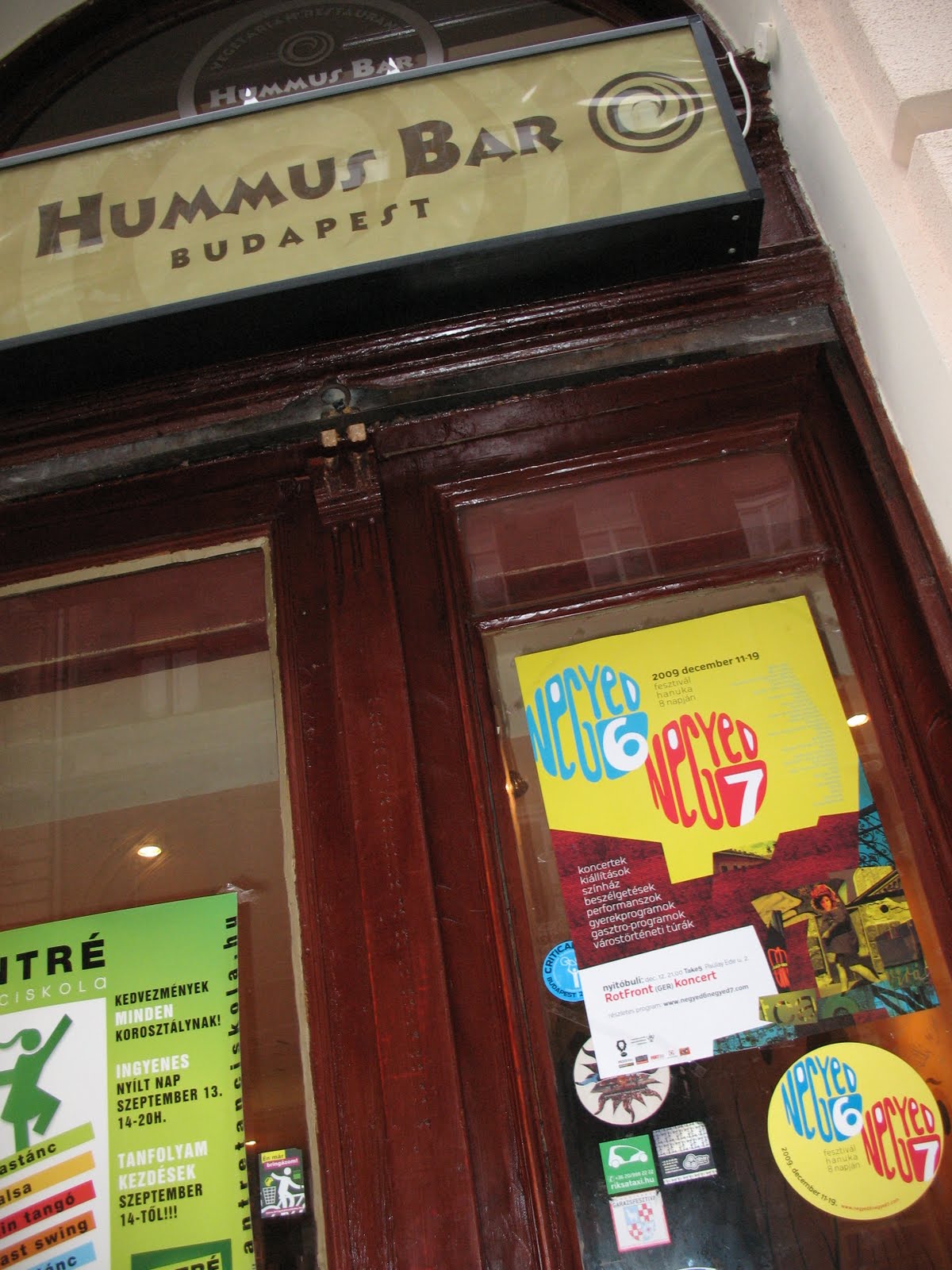
 The Hummus bar on Kertesz utca. Photo (c) Ruth Ellen Gruber


My latest travel column for Centropa.org is a guide to some of the cafes and restaurants I like to hang out in  in Budapest's old downtown Jewish quarter.

Budapest's Seventh District Wakes Up
By Ruth Ellen Gruber


BUDAPEST -- The last time I wrote about Budapest on Centropa I provided an itinerary of Jewish sights and resources, most of them in and around the city's Seventh District, the old downtown Jewish quarter anchored by three grand synagogues forming a so-called "Jewish triangle." 
That was eight years ago, and the former Jewish quarter still had the reputation of being one of the city's poorest inner districts. There were some signs of incipient gentrification, but World War II bullet holes pocked many crumbling facades, vacant lots yawned, and the grimy streets were dark and uninviting. A lot has changed since then.
Much of the District is still neglected. But already at the end of 2007 the New York Times ran a travel story called "Out of Darkness, New Life" that described how the district's "history and recent rise to trendiness" evoke "comparisons to the Lower East Side of New York." A recent issue of Time Out Budapest magazine went even further, terming the Jewish quarter a major city "bar vortex." In fact, the district burgeons with new cafes, clubs, bistros and wine bars that attract a young, hip -- and often Jewish -- crowd.
At the same time, though, this type of growth has been paralleled by controversial urban renewal projects that have seen many old buildings torn down and replaced by rather soulless modern structures.  A citizens group, OVAS, has been formed to lobby for the protection of what remains -- particularly in light of real estate corruption involved in some of the development schemes. The Mayor of the Seventh District himself, in fact, was jailed last year on suspicion of bribery and abuse of office related to property transactions.
I've maintained a small apartment in the Seventh District for more than a decade. Though I only spend part of my time here, I've been observing the changes in the quarter up close; after all, it's my neighborhood.
In particular, I enjoy the new venues and Jewish haunts that have nothing to do with a nostalgic sense of a vanished past but everything to do with how Jews in Budapest -- and particularly young Jews in Budapest -- are experimenting with ways to build a lively present and, one hopes, a sustainable future.
With this article, I would like to introduce readers to some of the haunts in and around the Jewish quarter that I tend to frequent: whether for breakfast cappuccino or afternoon espresso, for an inexpensive lunch, or for dinner or late night drinks and conversation. Or simply as somewhere to sit and use the free WiFi internet that most venues in the district seem to offer.
As I noted in my earlier Centropa article on Budapest, the Seventh District was the first and most important Jewish quarter in Pest, the flat part of Budapest that spreads out on the eastern bank of the Danube.
Today's downtown Deak Square and the massive red brick Madach apartment complex occupy the site of Orczy House, a vast structure built in the 1700s that was a central focus of Jewish life in Budapest throughout the 19th century.  Orczy House was demolished as part of an urban renewal project in the 1930s. Before that, it served as a self-contained warren of synagogues, study houses, apartments, baths, restaurants, cafes, shops, warehouses, and workshops: the place where many Jews from the provinces first found a home when they moved into the big city.
The broader Jewish quarter eventually spread out from here, with Kiraly street, at the edge of the Seventh, becoming its major commercial avenue, a heavily trafficked thoroughfare lined by many fine neoclassical buildings.  The back streets branching off Kiraly street into the Seventh comprised a dense network of shops, artisans' workshops, and tenements built around connecting courtyards encircled by balconies and tiny flats. At the heart of the district was what is now called Klauzal square, an open space fronting one of the city's district market halls that became the center of the World War II ghetto.
The three main synagogues that form the "Jewish Triangle" are all in the inner part of the district -- the twin-towered Dohany St. synagogue and the orthodox synagogue complex on Kazinczy street, both in use and both fully restored and refurbished in recent years, and the Moorish-style synagogue on Rumbach street, which still stands disused and in disrepair, after restoration was halted for lack of funds.
Most of the cafes and other venues I mention are within a ten-minute walk of these synagogues, and are also close to two synagogues run by Chabad, one on Deak square and one on Vasvary Pal street.
These are only a few of the many cafes and restaurants in the district -- but they tend to be the one that I (and my friends) frequent.
          Read Full Article

Monday, February 22, 2010

RUTHLESS COSMOPOLITAN -- Il Duce online

My latest Ruthless Cosmopolitan column is about the flap over iMussolini -- the app for the IPhone and IPod touch that at the end of January was the best-selling app on the Italian ITunes store...

iMussolini collated the texts of more than 120 of Benito Mussolini's speeches, plus audio and video clips of the Italian dictator in action.

 iMussolini app flap restirs debate on Il Duce’s legacy

By Ruth Ellen Gruber · February 21, 2010
ROME (JTA) -- Over the past few days I've been watching online videos of "Il Duce," Italy's World War II fascist dictator Benito Mussolini.
There are hundreds on YouTube, and some of the clips have been viewed hundreds of thousands of times.
Most are taken from the fascist-era newsreels that were part of Mussolini's powerful propaganda machine.
They show military parades and motorcades, or Il Duce, with his jackboots and jutting chin, orating before enormous adoring crowds. Quite a few are pro-fascist tributes posted by admirers who even today regard Mussolini as their ideological guide
What prompted my interest was the recent flap over iMussolini, an iPhone application that collated the texts of more than 120 of Mussolini's speeches, plus audio and video clips of the dictator in action.
iMussolini went up on the Italian iTunes store on Jan. 21, and with more than 1,000 downloads a day was the site's best-selling app until it was yanked two weeks later because of possible copyright violation of material in the state archives. A revised version, which added text but deleted audio, went back on sale Feb. 9
iMussolini has caused a stir in a country where Il Duce and his legacy remain a divisive issue.
Comments left on the YouTube clips run the gamut from passionate affirmations of "Viva il Duce!" to utter condemnation.
"It's disgusting," reads one of the more than 6,000 responses to a clip of Mussolini's speech declaring war in 1940. "Our fathers and grandfathers were completely crazy, robbed of their brains, reduced to being shameful assassins."
Mussolini came to power in Italy in 1922, when he and his fascist forces marched on Rome. Under his iron-fisted regime, Italy took many steps toward modernization. But he led the country into ruin with his disastrous alliance with Nazi Germany and instituted harsh anti-Semitic laws in 1938. Partisans executed Mussolini and his mistress in 1945, and their bodies were strung up by their heels in a Milan piazza.
Fascism is outlawed in Italy today, but some Italians now equate both fascists and partisans as patriots, and a visible segment of the political far-right regards Mussolini as a hero. His tomb in the northeast town of Predappio is a place of pilgrimage, where souvenir shops sell all sorts of fascist memorabilia. Skinheads give the fascist salute in his honor, and there are flourishing Mussolini groups on Facebook -- one boasts more than 6,000 fans.
The iMussolini app's developer, 25-year-old Luigi Marino, denies wanting to cash in on fascist nostalgia. He said he created his app simply by collating historical material that is freely available in bookstores, in libraries and online.
Presenting it without comment, he says on the iTunes site, enables an "unconditioned analysis of what took place in those years."
Others see it quite differently.
One leftist group called iMussolini a "hymn to fascism." And a Holocaust survivor association branded it "an insult to the memory of all victims of Nazism and fascism" and an "offense to decency and conscience."
In fact, there is a complex dilemma involved.
Mussolini's rule -- and the power he exercised over his countrymen -- formed an epoch of Italian history whose impact is still being felt today.
Postwar Italian democracy was built on a foundation of anti-fascism that exalted the wartime anti-fascist resistance while it minimized the extent to which many Italians had supported Mussolini’s regime -- indeed, before 1938, Fascist Party ranks had included thousands of Jews.
In recent years, new debates over the "true" nature of Italian fascism and its legacy have arisen, along with a less ideological examination of history that seeks to separate myth from fact.
The speeches on the iMussolini app, "like them or not, form part of history," said Il Duce's granddaughter, Alessandra Mussolini, a longtime right-wing member of the Italian parliament. "But if you want to wipe out history with censorship, help yourself."
With the iMussolini app, however, the issue is not censorship. It is, instead, where the line gets drawn between history and opinion, facts and propaganda.
"This is an ugly side of Italian history and is not something to be sold on iTunes, out of context, like a video game or song," said Angelo Pontecorboli, a Florence-based artist and publisher. "For thousands of Italian Jews like me," he added, "it was part of our suffering."
I didn't buy iMussolini when the app first came out. But when the revised version went on line, I decided to invest $2 and take a look.
It's a little creepy.
For one thing, most of the user comments on the iTunes site come from nostalgic pro-fascists who, as one put it, found it "great to have il Duce always with me."
Then on the app itself, a disclaimer that it "does not intend to celebrate Fascism but exclusively contains historical documents" is misleading.
The app's biography of Mussolini clearly was written from the standpoint of an admirer. And the "historical documents" it contains provide a sanitized picture of his regime that is far from complete.
The app's list of laws, public works and other measures taken under fascism, for example, notes how under Mussolini the Italian railways became "the best outfitted and most efficient in Europe." But it fails to mention the regime's sexism, militarism and harsh suppression of dissent. Or even the 1938 racial laws that made anti-Semitic persecution a fundamental part of fascism's guiding principles.
Read the story on JTA

Thursday, January 14, 2010

RUTHLESS COSMOPOLITAN -- Riffing on the Swiss minaret ban

Oops -- I forgot to post this last month.... my Ruthless Cosmopolitan column riffing on the Swiss minaret ban and historic bans on synagogue architecture.

RUTHLESS COSMOPOLITAN
Swiss minaret ban recalls synagogue bans of past eras

By Ruth Ellen Gruber · December 14, 2009


VILNIUS, Lithuania (JTA) -- A week after the Swiss referendum banning the construction of new mosque minarets in Switzerland, I flew to Vilnius, Lithuania, for a seminar that focused on the destruction of Jewish heritage in Lithuania during the Holocaust.

The timing was coincidental. And I realize that the Swiss voters who overwhelmingly approved the minaret ban were responding to scare tactics that raised the specter of an extremist Islamic takeover in their country.

Yet in a certain way, the Swiss vote Nov. 29 and the Lithuanian seminar were connected.

To me, the ban on minarets recalled centuries of restrictions on the size or prominence of synagogues. The Swiss ban is just the latest example of how governmental authorities target religious architecture as a means of limiting religious or cultural expression.

From early medieval times, synagogues in Europe often were forbidden to stand taller than Christian churches, and in many cases they were forbidden even to be outwardly visible. There were restrictions on synagogue architecture in Muslim countries, too.

This had nothing to do with zoning. It was a way for the dominant religion to demonstrate control over minority faiths, their practice and their adherents.

Opulently decorated synagogue sanctuaries often were hidden behind anonymous exteriors, and a number of synagogues had their floors and foundations laid much lower than street level so they wouldn't be too tall. These included Vilnius' own Great Synagogue, which was built in the early 17th century.

But religious architecture, too, often suffered much worse than restrictive regulation; it was targeted for destruction as a symbol of the people who prayed there.

"Beginning in the fourth century and continuing through the Middle Ages, and again in the 20th century, the 'legal' restriction and destruction of synagogues quickly led to the same policies applied against individuals, and then whole communities," said Samuel Gruber, president of the International Survey of Jewish Monuments.

(Sam is one of the leading international authorities on Jewish heritage -- and also my brother. We have worked together for many years on issues related to Jewish heritage preservation.)

During the Holocaust, the Nazis torched, blew up or desecrated hundreds of synagogues with the same fervor that they devoted to destroying Jewish communities, culture and civilization.

More recently, during the Yugoslav wars in the 1990s, Orthodox Serb, Catholic Croat and Muslim Bosniak fighters destroyed mosques, churches and other culturally significant places.

The term "warchitecture" was coined at the time to describe the deliberate destruction of architectural heritage as a tool of conflict or persecution.

The lasting impact of the Holocaust destruction of Jewish heritage was the focus of our seminar in Vilnius. It brought together representatives of various local institutions to discuss how the important Jewish contribution to the history and culture of Vilnius could most effectively be made known to today's residents and visitors.

How to convey what was lost in the absence of tangible traces was a key part of the agenda.

"In a sense we are in search of the lost Vilnius," said Deividas Matulionis, chancellor to Lithuania’s prime minister.

Vilnius, known in Yiddish as Vilna, was the so-called Jerusalem of the North. It was home in the 18th century to one of modern Judaism's most influential intellectual and spiritual leaders, the so-called Vilna Gaon, Elijah ben Solomon Zalman.

Before World War II, about 100,000 Jews lived here. The Great Synagogue, standing in the heart of what is today's postcard-perfect Old Town, was the most magnificent of more than 100 synagogues and prayer houses in the city.

The Vilnius Old Town today is on UNESCO's roster of World Heritage Sites, but almost no physical traces of its Jewish past remain. There are a few street names, wall inscriptions and plaques, but that's it.

The Great Synagogue itself, and the teeming Jewish quarter around it, was bombed during World War II and its ruins were razed by the Soviets in the 1950s. A kindergarten was built on the site.

Controversy has raged for years over what to do with the old Jewish quarter.

One multimillion-dollar plan, promoted by a Jewish member of Parliament and activist, Emanuelis Zingeris, called for sites, including the Great synagogue, to be rebuilt. The plan was approved but never really got off the ground due to financial considerations and opposition from within the 5,000-member Jewish community.

Complicating matters is Lithuanian society’s ambivalence about its past. Local nationalists regard the Nazis as liberators and the postwar Soviet government as an occupier, and anti-Nazi activity gets conflated with Soviet oppression. The Genocide Victims Museum in Vilnius is mainly about the Soviet persecution of Lithuanians between 1940 and 1991.

Local Lithuanians collaborated with Nazis to help kill about 90 percent of the 250,000 Jews who lived in Lithuania before the war. For Holocaust survivors, the Soviets were liberators before they became an occupying power.

The destruction of nearly all traces of Jewish historic presence in Vilnius left a gaping hole that has yet to be filled.

I know it's a very long way from a ban on new minarets to the much more drastic measures that led to this state of affairs. But as my brother Sam put it, "Restricting specific types of religious or cultural expression -- especially when such restrictions are deliberate exceptions to existing building, zoning, health and safety codes -- is discriminatory."

It is, he said, "an act of denigration of cultural custom and, by extension, of the people who cherish, or the religion that requires, those very customs."

RUTHLESS COSMOPOLITAN -- Arson attack on synagogue in Crete

My latest Ruthless Cosmopolitan column riffs on the arson attack last week on the Etz Hayyim synagogue in Hania, Crete. Read the story at the JTA web site by clicking HERE.

RUTHLESS COSMOPOLITAN
Attack on Crete synagogue carries special meaning

By Ruth Ellen Gruber · January 13, 2010

ROME (JTA) -- The vandals who torched the historic Etz Hayyim synagogue in Hania, an ancient port on the Greek island of Crete, left no doubt about their motives.

After breaking into the building on the night of Jan. 5 and setting its interior alight, they threw a bar of soap against its outer wall.

A bar of soap? That's because, explains the synagogue's director, Nikos Stavroulakis, "I'll make you into a bar of soap" is a common anti-Semitic taunt in Greece. Since the Holocaust, there has been a persistent belief that the Nazis made soap from Jewish corpses.

Even though scholars have disproved the idea, bars of soap have been buried reverently in some European Jewish cemeteries under solemn memorials.

"In this place lie the remains of Jewish martyrs exterminated by German fascists and turned into soap," reads the inscription on an obelisk in Piatra Neamt, Romania.

The power of this belief was examined in "The Soap Myth," a play by Jeff Cohen that ran last summer in New York. Based on a true story, the play focused on the efforts of an elderly Holocaust survivor "on a one-man mission to get the 'soap myth' reclassified as fact," Marissa Brostoff wrote in Tablet magazine.

But at the heart of the story was something much more.

What was at stake, Brostoff wrote, was "the way we choose to see the past, a struggle between a dispassionate approach relying on facts and figures and another, much more subjective one that holds survivors' testimonies to be unarguably true and ultimately sacred."

Anti-Semitic violence is anything but dispassionate.

The bar of soap hurled against the desecrated synagogue in Hania was a diabolically mixed metaphor: Soap usually symbolizes purity and godliness, but in this twisted context it spelled hatred and death.

The attack on the Hania synagogue was not just an assault on a building. It was an assault on the ideals that had transformed the structure from a wrecked relic of Holocaust destruction to a new symbol of community and compassion.

This transformation was accomplished largely through the efforts of Stavroulakis, a remarkable man who has devoted much of the past two decades to restoring a Jewish presence to a city made "Judenrein" by the Nazis.

I met Stavroulakis when I visited Hania in 1996. An artist, author and scholar who had co-founded and directed the Jewish Museum in Athens, Stavroulakis had returned to live in his family's rambling house in Hania after many years away.

The synagogue, which dates back to the 15th century, was in ruin. But over the next three years Stavroulakis made it his mission to raise funds and, with the help of the World Monuments Fund and other donors, oversee the building's rebirth. His aim was to make it a living spiritual presence, not simply a restored reminder of the past.

The synagogue now functions as a museum, and it hosts exhibitions and cultural events.

It’s also an active house of worship. A small Havurah community whose members include Christians and some Muslims -- as well as Jews of all persuasions -- regularly assembles there to celebrate Shabbat and Jewish holidays.

Stavroulakis himself leads daily prayers each morning, whether a minyan is present or not.

Prayers were held as usual at 9 a.m. Jan. 6, the morning after the arson attack. The fire had gutted a stairway, wreaked havoc on the synagogue library, and covered walls and precious furnishings with a thick layer of soot.

"Fortunately," Stavroulakis said, "the fabric of the synagogue was and is intact."

He was referring to the physical structure of the building, but I think he also meant that the symbolic identity of the synagogue also had survived -- and would be maintained.

"We must be angry over what has happened to our synagogue," he told the small group of worshipers gathered for prayers amid the soot. "If we were not, it would be an indication that we were either indifferent or morally numb."

But, Stavroulakis asked, just where should the anger be directed? Local indifference and the ignorance that promotes racism had to be addressed.

"We have tried at Etz Hayyim to be a small presence in the midst of what is at times almost aggressive ignorance," he wrote on the synagogue blog. "We have done this to such a degree that our doors are open from early in the morning until late in the day so that the synagogue assumes its role as a place of prayer, recollection and reconciliation."

There is, Stavroulakis wrote, little if any sign of overt security.

"This character of the synagogue must not change and the doors must remain open," he wrote. If not, that means "we have given in to the ignorance that has perpetrated this desecration."

A week after the attack, the Etz Hayyim blog posted pictures showing that thanks in large part to volunteers, the walls of the sanctuary already had been painted and other clean-up work was well under way.

"The impact of this [attack] will be wider than simply an act of terrorism against Jews," Stavroulakis told me. "Already it is being seen in a much wider social context that has to do with civic responsibility and care."

Thursday, December 17, 2009

Tablet Magazine -- Olive Oil

Here's a link to my Hanukkah story in Tablet Magazine, on the olive oil harvest...


My Hanukkah Gift
A writer’s reflections on her olive grove and a holiday ritual
By Ruth Ellen Gruber. December 17, 2009


It’s surely just a coincidence that in Italy, where I have a home, the olive harvest generally takes place in the month or so before the most oil-centered of Jewish holidays.
For me, though, the olive harvest and subsequent production of oil provide a parallel seasonal ritual, in which bruschetta, or grilled bread drenched in dense new oil, provides the ceremonial flavor.
My family and I have property in an olive-producing area of Umbria, in central Italy, where the landscape is a hilly mix of forest and farmland, and many of the slopes are covered with groves of olive trees.

Umbria is home to several big olive oil concerns, with huge groves comprising thousands of trees. But many people, like me, have small private holdings that provide enough oil for their own needs, as well as a portion left over for sale.

On our land, we have several dozen olive trees. I keep most of them pruned, but otherwise, I admit, I’m a very poor farmer. I don’t plow or fertilize or do much else to care for them; I regard what they produce as something of a gift, and only about half of the trees, in fact, bear fruit.

Still, each November sees me out in the field, gathering olives and then having them taken to a local frantoio, or olive press, where they are turned into oil.
Read full story

Saturday, November 14, 2009

Sturm , Twang, and Sauerkraut Cowboys -- article in The Western Way

The Western Way magazine has published a much shorter version of the lengthy essay/paper on European country music that I wrote with the aid of my Guggenheim Fellowship and NEH grant, and presented at the International Country Music Conference in Nashville last year (and in other venues).
A full version of the essay, with pictures, can be viewed by clicking HERE.