Thursday, September 10, 2009

RUTHLESS COSMOPOLITAN - A Tale of Two Synagogues

Dohany St. Synagogue, 150 years (young). Photo (c) Ruth Ellen Gruber


My latest Ruthless Cosmopolitan column is about the big birthdays of the great synagogues in Budapest and Sofia.


RUTHLESS COSMOPOLITAN

By Ruth Ellen Gruber

Sept. 7, 2009

BUDAPEST, Hungary (JTA) -- This year marks a number of momentous anniversaries: the 70th anniversary of the outbreak of World War II; the 40th anniversary of Woodstock; the 20th anniversary of the fall of communism.

We use anniversaries like these to stop, step back and evaluate not just the event that's being commemorated, but also the passage of time since it happened and the changes wrought with that passage.

In this context, two significant Jewish anniversaries are taking place in September.

The Dohany Street Synagogue in Budapest -- the largest synagogue in Europe -- turns 150 years old. And the Great Synagogue in the Bulgarian capital of Sofia turns 100.

OK, they are buildings, not earth-shaking events. But given the impact that some of the other "big" anniversaries had on these synagogues and on what they represent, it's only fitting to highlight their birthdays on the roster of celebrations.

For one, both are magnificent buildings that stand out architecturally as important city landmarks. Partly because of this, both have undergone recent renovations that restored them to opulent glory after decades of postwar neglect.

Both also are flagships of faith, or at least of Jewish identity, and are survivors, too. Witnesses to the pendulum swing of tragedy and triumph that has marked Jewish history in the region, they are potent physical symbols of a proud and enduring Jewish presence.

"The Dohany Synagogue is still the main synagogue of all the Jews of Hungary, the main identity place where we gather, whether we are religious or not," said architectural historian Rudolf Klein, author of the 2008 book about the synagogue, “The Great Synagogue of Budapest.”

As many as 90,000 Jews are believed to live in Budapest, but most are unaffiliated or totally secular.

With its red-and-yellow striped facade, sumptuous decor and two tall spires topped by gilded onion domes, the Dohany is, in fact, one of the most distinctive buildings in the city and was recognized as such from the outset.

Designed by the Viennese architect Ludwig von Forster, it was inaugurated on Sept. 6, 1859. Old engravings show dignitaries in shiny top hats gathered in front of its enormous ark, a domed and gilded structure that itself is the size of a small chapel.

At the time, Jews had not yet achieved full civil rights in Austro-Hungary. Yet the synagogue was the largest house of worship in Budapest and probably the biggest synagogue in the world. One local newspaper called it "a gorgeous piece of architecture."

"I like it as a Jew and as an architect," Klein told JTA. "In both areas it was a breakthrough."

The synagogue's Moorish style launched a genre and set the pattern for hundreds of synagogues built in later years throughout Central Europe and beyond.

The building's monumental scale, its prominent location and its opulent ornamentation, Klein said, epitomized "the optimism of 19th-century Jewry and the tolerant attitude of the gentile world which prevailed in the capital" at the time.

Things, of course, changed later. During World War II the synagogue was used as a concentration camp, where Jews were massed before their deportation to Auschwitz. The graves of Holocaust victims fill the courtyard.

After the war, under communism, the building languished for decades in a sorry state of disrepair. I vividly remember how its ceiling, held up by cables and plastic sheeting, sagged perilously over the congregation that would pack the sanctuary on Yom Kippur simply to make a statement of identity in the face of the regime’s religious suppression.

In 1996, it was officially reopened following a five-year restoration that was financed largely by the newly democratic Hungarian state.

"This building symbolizes the survival and the continuity of the Jewish people," Gusztav Zoltai, chairman of the Association of Hungarian Jewish Communities, declared at the time.

The Sofia synagogue was inaugurated in September 1909, nearly 50 years to the day after the Dohany, and fulfilled a similar role.

Czar Ferdinand himself cut a ribbon to formally inaugurate the building, whose huge dome, slim turrets and lavish, Byzantine-Moorish style fit in with many other grand buildings in downtown Sofia. The prime minister, other government VIPs and local bishops were in the crowd, too, and a procession of rabbis bore Torah scrolls into the sanctuary and placed them in the ark.

"This synagogue will connect us with the past generations and will tell of us to the future ones," the chief rabbi proudly told the congregation 100 years ago. "May God bless this land which we love dearly, for the good of all Bulgarians, in whose sufferings and joys we take an active part."

Bulgaria's 50,000 Jews were saved during World War II by the heroic action of some of the country's leaders, and most of them moved to Israel.

The Great Synagogue, damaged in 1944 by Allied bombing, stood neglected for decades, as Communist authorities unsuccessfully tried to turn it into a concert hall.

Still, recalled Robert Djerassi, one of the chairmen of the synagogue centenary celebrations, "It was an enormous domed building that awed me with its magnificence each time I stepped inside. Such a huge void: fearsome, lofty, dark and mysterious!"

Only a few thousand Jews live in Bulgaria today, but as in Budapest, restoration of the synagogue was a priority after the fall of communism as a public demonstration of both Jewish renewal and Jewish presence in the city.

The first stage of work was completed in 1996, the final one this year, just in time for September's five-day birthday bash.

Bulgarian President Georgi Parvanov served as honorary chairman of the gala events, echoing the high-profile participation in the synagogue's original dedication a century ago. I'm not sure if I found this moving or ironic, but I'm rather glad he chose to do so.


Read Full Story at JTA

Friday, August 21, 2009

Bielsko-Biala -- My latest Centropa column

Jewish-style restaurant in Bielsko-Biala. Photo (c) Ruth Ellen Gruber

Here's a link to my latest column for Centropa.org, on Bielsko-Biala, Poland.

BIELSKO BIALA

Published Aug. 20, 2009

Before visiting Bielsko-Biala in southern Poland, I went online to check hotels. One of them, I found, was offering what it called a "Jewish Heritage Package."

Terrific, I thought. I was going to Bielsko-Biala for something else -- an international performance art festival. But I knew the town is rich in Jewish history, and I was looking forward to exploring it in more detail. Then I clicked the link and saw the itinerary.


Read full story

Tuesday, August 4, 2009

My Article on Silesia, on IHT/NYT web site

My article on the Industrial Heritage Route in Poland's Silesia province, in the International Herald Tribune and New York Times web site.


The monument to Wincenty Pstrowski, a miner and Communist-era labor hero, in Zabrze.Photo 9c0 Ruth Ellen Gruber

A Road Trip Through a Revolution, Mine by Mine and Factory by Factory

By Ruth Ellen Gruber (July 30, 2009)

ZABRZE, POLAND — A bell rings out with a strident clang, and the metal cage begins a slow descent into the earth.

The Nikisowiec workers' housing estate, which was built between 1908 and 1915 for workers at the Wieczorek coal mine.

As I stand inside, helmet on head, shoulder to shoulder with a group of slightly nervous strangers, the refrain of a Merle Travis song keeps running through my head: “It’s dark as a dungeon, damp as the dew/ the dangers are double, the pleasures are few/ where the rain never falls, the sun never shines/ it’s dark as a dungeon way down in the mine.”

I’m headed down 320 meters, or about 1,050 feet, on a guided tour of the Guido Coal Mine, which was founded in 1855 in Zabrze and closed decades ago.

Today it’s a mining heritage park: its soaring shaft tower the dominant feature of a complex that includes a subterranean museum showcasing more than a century of coal-mining technology — from hand-held picks to huge automated drills that resemble creatures from a sci-fi film — and a research center for industrial tourism.

The mine is a key stop among the 31 sites on the Industrial Monuments Route, which opened three years ago as a kind of tourists’ alternative to the country’s castles and churches. Crossing Silesia Province in the south, the route pays homage to the heritage of the country’s most heavily industrialized region.

This region is essentially Poland’s Rust Belt. The route includes not only mines but foundries, factories, railway stations, power plants, even a wooden radio tower in Gliwice. Some of the facilities are still in operation.

The route also includes museums devoted to specific areas of trade and manufacturing — beer museums at well-known breweries in Zywiec and Tychy; a bread-making museum near Bytom; a press and publishing museum in Pszyczyna; and a textile industry museum in Bielsko Biala. A small Museum of Sanitary Technology, located in a century-old waste-water pumping station in Gliwice, shows the history of sewage treatment technology.

Most sites date to the region’s Industrial Revolution in the latter part of the 19th century, when belching smoke from thousands of red-bricked chimneys darkened the Silesian sky, and mines and mills transformed, and blighted, the landscape.

Many of these installations functioned throughout the Communist years. But though Silesia is still heavily industrial, most of its aging plants have either closed or modernized, and much of the old machinery has been scrapped.

The route, in fact, was set up to single out and preserve the more noteworthy of those that remain.

I’ve always been fascinated by the mechanics of heavy industry and the almost sculptural forms of mine towers and factory smokestacks. In the course of a few days I took in many of the listed monuments, visiting some as easy day trips from Krakow and others while staying nearby.

Zabrze, near Katowice, has several listed sites. Before visiting the Guido Mine, I toured an open-air display of shaft machinery at the Krolowa Luiza mining complex. And I admired the monumental sculpture of a weary yet heroic coal miner — the Communist-era workers’ hero Wincenty Pstrowski — that dominates a city park across the street from a museum of mining history.

Two train stations provided a stark contrast. The one in Bielsko Biala, built in 1890 and recently restored, looks like a temple to transportation with elaborate frescoes. The station in Rada Slaska Chebzie, however, stands almost derelict, its red brick, glass and cast-iron facade covered in graffiti.

One site I found particularly striking was the Nikiszowiec Workers’ Housing Estate outside Katowice. One of several such estates included on the route, the Nikiszowiec development was built between 1908-15 for workers at the adjacent — and still functioning — Wieczorek coal mine. It’s a sprawling tract of three-story, red brick apartment buildings, arranged around a large red brick church and connected by courtyards and archways.

Mine workers still live there — I ran into some of them, still in their helmets, coming home after their shift — and the place has a gritty, proletarian air. But there is also evidence of nascent gentrification: window frames are freshly painted in a vivid red, and cafes have begun to appear.

The Industrial Monuments Route is designed as a car route. Some sites, though, can be reached on foot or by public transportation. I drove, but in Bielsko Biala, for example, both the train station and the Textile Industry Museum, with its fascinating collection of looms and mill machinery, were within walking distance of my hotel.

To get around, I used a free illustrated map available in English at tourist information offices. It provides a brief description and photograph of each site, and locates them on general and local maps. (Detailed information is available on the English-language Web site www.silesia-region.pl/szt/en/inf_turyst.html.)

But even with the map, finding my way around was not always easy. Many of the sites are well off the beaten path, and roads, highways and signage, particularly in the heavily congested areas in and around Katowice, can be confusing — I wished more than once that my car had GPS

Read full article on New York Times web site

RUTHLESS COSMOPOLITAN -- Summer Reading and the Holocaust

Holocaust memorial in Budapest, on the bank of the Danube. Photo (c) Ruth Ellen Gruber


My latest Ruthless Cosmopolitan column deals with three books by people I know -- The Shanghai Moon, a detective story by S.J. Rozan, The Budapest Protocol, a political thriller by Adam LeBor and The Pages In Between, a memoir by Erin Einhorn. The books are very different, but they deals with how the Holocaust and associated with it, have an impact today.


RUTHLESS COSMOPOLITAN: Summer Reading and the Holocaust

By Ruth Ellen Gruber (July 29, 2009)

BUDAPEST (JTA) -- Summer's here and my recreational reading has included three books by people I actually know.

Each book is quite different from the others -- "The Shanghai Moon" by S.J. Rozan is a detective story; "The Budapest Protocol" by Adam Le Bor is a political thriller; and "The Pages In Between" by Erin Einhorn is a nonfiction personal memoir.

But they all have something in common: They use the Holocaust and the lingering impact of its memory as springboards for narratives that take place in the present. And fiction or nonfiction, all three books are gripping yarns that make readers think, as well as become lost in the story.

"The Shanghai Moon" is the latest in Rozan's award-winning series of mysteries featuring New York-based detectives Lydia Chin and Bill Smith. It hinges on the experiences of the more than 20,000 European Jews who found refuge in Shanghai, China, during the Shoah and on the fate of their looted belongings. The book is the first in her series in which Rozan explores Jewish themes. Like the other two authors, Rozan is Jewish.

"The Shanghai ghetto is a compelling aspect of Jewish and Holocaust history that gets almost no attention," Rozan told me when I asked her what prompted her to write about it. "Once I started the research, I was completely enthralled with these people's stories and thought that whole rich world needed to be brought to light.

"The past never stops reaching into the present,” she said. “In a sense, crime and mystery novels are all about making that clear, about bringing above the surface, as it were, how and when that happens.”

Rozan said she occasionally hears from people who were in the Shanghai ghetto or had family members there.

"They almost never encounter that time and place in fiction, and they're thrilled to see it," she said. "And I'm thrilled when they tell me my picture of it feels right to them."

"The Budapest Protocol" tells quite a different story. Le Bor, a veteran British journalist and author, sets his story in the Hungarian capital, where he lives. But he creates an alternative Budapest, using today's city -- including its former Jewish quarter -- as a backdrop for an imaginary political scene in which Nazi-inspired political forces gain power in a bid to take over Europe.

Le Bor told me he extrapolated from a 1944 U.S. intelligence document an account of a meeting of leading Nazi industrialists in the Maison Rouge Hotel in Strasbourg, France. They admit the war is lost but lay out their plans for the next Reich, the fourth, which will be an economic empire.

"I simply moved that meeting to the fictional Hotel Savoy in Budapest and took the story from there," the author said.

Le Bor described the book -- his first novel after several nonfiction books -- as weaving "past and present together, just like everyday life everywhere in Eastern Europe.

"We walk on pavements once trodden by the Gestapo and the [Hungarian fascist] Arrow Cross, we marvel at the beauty of the Danube, which within living memory was also a watery grave for thousands of Jews," he said.

"But Hungary, certainly more than its neighbors, is making real efforts to remember what was lost at numerous memorials and Holocaust commemoration ceremonies. It also celebrates what remains at events like the Jewish summer festival," an annual event at the beginning of September.

"Jewish culture," Le Bor said, "is an ever-richer part of Budapest life."

Erin Einhorn's nonfiction memoir, "The Pages In Between," gripped me as much as -- or more than -- any fictional thriller.

The Detroit News called it "a detective story framed as a memoir." The story's subplots, it said, "reveal how memory often distorts the truth, and how family legend is often colored in its retelling."

The book recounts Einhorn's attempts to find out the truth about how her mother, who was born in the Polish city of Bedzin in 1942, survived the Holocaust.

Einhorn, then in her 20s, moved to Poland for a year in 2001. She found the house in Bedzin that once belonged to her family, met the descendants of the Christian woman who took in her mother as a baby and became immersed in an ever-widening web of truths, half-truths, myth and deception.

A reporter with the New York Daily News, Einhorn uses her journalistic skills to record not only her search for her mother's past but also her search to understand the present -- and, in a way, her search for her own identity.

Along the way she presents an honest and intensely vivid appraisal of contemporary Poland, especially the nuances and contradictions that compose the complexities of Poland's centuries-old relationship with the Jewish world.

Sadly, Einhorn's mother died at age 59, just as Einhorn was embarking on her project. That loss becomes a milestone that turns Einhorn's book into not just a search for family history, but a coming-of-age chronicle that links the past with an open-ended future.

I stayed up well past midnight to finish it.


Tuesday, June 30, 2009

RUTHLESS COSMOPOLITAN -- Michael Jackson and the Jewish Nose

In Vienna this weekend, I visited the Jewish Museum to see the exhibit "Typisch!" -- about Jewish and other ethnic stereotypes. The exhibition already has shown at the Jewish Museum in Berlin and at the Spertus Museum in Chicago. What should I find as one of the exhibits? Michael Jackson, who else....

So -- here's my latest Ruthless Cosmopolitan column about the experience.....

Poster for Typical!," an exhibit at the Jewish Museum in Vienna that features a photo of Michael Jackson used to illustrate how the singer tried to crush stereotypes. (Ruth Ellen Gruber)

Poster for Typical!," an exhibit at the Jewish Museum in Vienna that features a photo of Michael Jackson used to illustrate how the singer tried to crush stereotypes. (Ruth Ellen Gruber)
Ruthless Cosmopolitan: Michael Jackson and the Jewish nose

By Ruth Ellen Gruber - June 29, 2009

VIENNA (JTA) -- Amid all the noisy outpouring over Michael Jackson's sudden death, the last place I expected to find him was in a Jewish museum. But there he was, his pale, mask-like, surgically engineered image featured as part of an exhibition at the Jewish Museum in the Austrian capital.

Called "Typical! -- Cliches of Jews and Others," the exhibition deals with the use (and abuse) of ethnic stereotypes in popular culture. The exhibition, which runs until October, has been shown at the Jewish Museum in Berlin and the Spertus Museum in Chicago.

It was assembled long before Jackson died June 25 in Los Angeles.

In a life-size photograph from 2002, he is shown with lank black hair framing a long, square stubbly chin, pinched red mouth, huge made-up eyes and a tiny nose with distorted pointy tip.

The photo is used to illustrate how, for better or worse, the King of Pop attempted to destroy stereotypes and, literally, to cut himself away from the confines of physical definition.

Jackson's "surgical transformations mirrored back to the culture the blurring of boundaries demarcating adulthood, sex and even race," Guy Trebay wrote in The New York Times after Jackson's death.

The "Typical!" exhibition deals with stereotypes commonly used to categorize African Americans, Muslims, women, Native Americans and others.

But given that it is mounted at a Jewish museum, much of its focus is on stereotypes about Jews. The exhibition poster employs a few sketched strokes to conjure up some: corkscrew curls, a hat and a huge hooked nose.

Indeed, the multitude of variations on the (alleged) size and shape of the Jewish nose form a major theme.

"The paradigm for the 'typically Jewish' nose originated in the craniological studies of Johann Friedrich Blumenbach," an information panel informs. A German natural scientist who died in 1840, Blumenbach "claimed to have evidence that Jews had an especially prominent nasal bone."

Exhibit installations examine the misuse of this and other paradigms in "scientific" teaching, as well as the ways in which they became part of the vernacular shorthand that shapes the way we see others and ourselves.

A section called "the schnoz," for example, shows a collection of 19th century walking sticks whose handles are formed by exaggerated noses. The contemporary artist Dennis Kardon's installation "Jewish Noses” features dozens of larger-than-life-sized casts made from the noses of actual Jews to demonstrate the silliness of such nasal cliches. Also, a modern painting ironically comments on the love and success that are supposed to result if one has a nose job.

"I am often asked whether or not Jews have a 'Semitic' nose," reads an exhibition quote by the historian Sander Gilman, who has written extensively about Jewish stereotypes. "After 54 years of experience, I can only answer that every Jew I have ever met has a nose."

The inclusion of Jackson's picture in the mix highlighted the transformations his own nose infamously went through.

It also reminded me of a book I read some years ago, a vicious anti-Semitic satire called "The Operated Jew," that was written in 1893 by a German doctor named Oskar Panizza.

An attack on efforts by Jews to assimilate into mainstream society, the book is a creepy and extremely disturbing tale about how a Jew named Itzig Faitel Stern tries to rid himself physically of the stereotypical signs of his Jewishness and become a "modern" European.

Foreshadowing Jackson's experiences under the knife, Stern submits to radical procedures, including the straightening and bleaching of his hair, "Extreme Makeover"-style cosmetic surgery and a series of horrendous operations to straighten his bones. He even gets a full transfusion of "Christian blood."

"It is impossible for me to give the reader an account of all the garnishings, changes, injections and quackeries to which Itzig Faitel Stern submitted himself," the narrator states. "He experienced the most excruciating pain and showed great heroism so he could become the equivalent of an occidental human being."

In the end, it doesn't help. At his wedding to a Christian woman, all falls apart and Stern "reverts" to the ugliest anti-Semitic cliche of the Jew.

Panizza, an early exponent of Nazi-style racial anti-Semitism, set out to "prove" that Jews could never become part of the mainstream modern world, even if they physically attempted to change their skins.

It's not exactly clear what world Jackson was trying to become part of -- or leave -- with his surgeries and other transformations.

Artistically he was the ultimate crossover, winning fans of all colors, ages, religions, nationalities and sexual orientations all around the world. Over the years, though, he alienated some African Americans by his physical manipulation of identity and apparent ambivalence about his own blackness.

Death, though, appears to have brought Jackson back to his roots -- or in any case to a warm embrace by the African-American community.

“We want to celebrate this black man," the actor and singer Jamie Foxx said to cheers at the Black Entertainment Television Music Awards Sunday. "He belongs to us, and we shared him with everybody else.”

Foxx added, "It didn't matter what he looked like, it was all about what he sounded like. It didn't matter what his nose looked like -- I loved the old nose and the new nose."

Read story on JTA

Tuesday, June 9, 2009

My lated Moked comment -- Samorin, Slovakia

My latest Moked piece -- from May. The Wounded Synagogue


La sinagoga ferita

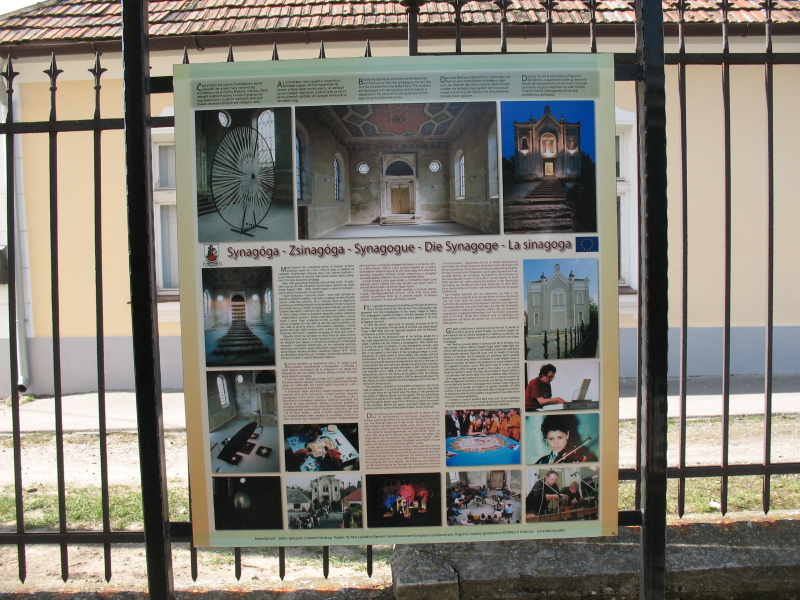
La storia rivelata in un cartellone. A Samorin, una piccola città slovacca vicino a Bratislava, un manifesto permanente narra in cinque lingue, compreso l’italiano, il modo in cui la sinagoga locale è stata riportata in vita dopo mezzo secolo di abbandono. La sinagoga era stata costruita nel 1912. Durante la Seconda Guerra Mondiale gli ebrei che vivevano lì furono sterminati. La sinagoga fu utilizzata come un deposito di munizioni, poi come magazzino di grano. La prima volta che l’ho vista, nel 1990, il suo stato di degrado e solitudine mi ha toccato veramente il cuore. Pochi anni dopo, una coppia canadese di origini slovacche e’ riuscita a salvarla. Rivolgendosi all’Unione ebraica di Bratislava, Suzanne e Csaba Kiss hanno preso in affitto la sinagoga e l’hanno trasformata in un centro per l’arte contemporanea. L’hanno chiamata la “At Home Gallery” — “La Galleria di casa.” Nessun ebreo vive più nel luogo. Ma la gente torna, ebrei e non ebrei, per assistere ai concerti, alle mostre e alle altre manifestazioni culturali. Lo stesso Dalai Lama è stato un ospite alcuni anni fa. Durante il restauro della sinagoga, i Kiss hanno preso una decisione importante. Hanno ripristinato perfettamente la facciata, ma dentro, invece, hanno lasciato tracce molto suggestive che testimoniano del danno e del degrado subito. “Le tramandano ricordi,” dice Csaba Kiss. “Li vediamo. E’ molto speciale.” Questa storia si legge sul cartellone che accoglie i visitatori.

Tuesday, June 2, 2009

RUTHLESS COSMOPOLITAN -- Bielsko Biala

Photo (c) Ruth Ellen Gruber

My latest Ruthless Cosmopolitan column is from Bielsko Biala, Poland, about the impact of perception on memory.

Poland’s Jewish heritage is about more than just death

BIELSKO-BIALA, Poland (JTA) -- Outside the elegant theater in the city of Bielsko Biala in southern Poland, a billboard advertises an upcoming play. Stark letters spell out the title: "Zyd" -- Jew.

The lettering looks almost menacing, like scrawled graffiti, and I am a little taken aback.

But then I remember where I am.

This is Poland.

And the play, in fact, is an award-winning exploration of anti-Semitism and the power of stereotypes -- part of the endless continuing discussion here about the Jewish past, the Jewish present, and the long, complex and troubled relationship between Jews and Catholic Poles.

"There is no theme that Poles are more likely to discuss than Jews," the play's author, Artur Palyga told the Polish media. "It can be said that Judaism is our national passion."

"Zyd" deals with teachers in a provincial Polish town preparing for the visit of a former student, a Holocaust survivor who had attended their school before the Shoah, when Jews made up more than half the town's population.

Its portrayal of grassroots prejudice is graphic and sometimes grotesque. Indeed, the play came under fire in the right-wing press, and its premiere last year sparked protests.

Still, it won the main prize at a national festival of contemporary Polish drama for being "an honest, brave and theatrically precise attempt to settle accounts with the difficult Polish past."

The play is essentially about memory. In particular, it’s about the various uses to which memory is put, and how memory differs in the minds of different people considering the same past.

These issues have suffused much of my own work over the past two decades, as I have researched Jewish heritage sites in East and Central Europe and chronicled the Jewish experience in places were few or no Jews live today.

How are Jews and Jewish heritage remembered? Which Jewish places and personalities are incorporated into the local consciousness? How do local people choose to portray an important part of the population that was savagely removed, almost overnight?

I found Bielko Biala permeated with examples of how perspective influences memory.

They ranged from indifferent disregard to the kitschy commercialization of a "Jewish-style" restaurant called Rabbi, to an earnest attempt to acknowledge the contribution of Jews to the city.

Bielsko Biala was officially established in 1951 with the amalgamation of two towns on opposite sides of the Biala River, which for centuries formed the border between the Austrian Empire and Poland, and then the regions of Silesia and Galicia.

Before 1939, the population was divided among ethnic Germans, Jews and Poles, and the city remains a stronghold of Protestantism. The Nazis absorbed it into the Reich, and almost all the Jews were killed. After World War II, Poland took it over and expelled the ethnic Germans.

Only a small Jewish community lives here today, but Jews played a major role in local history. In the 19th century, Jewish industrialists helped build the city into a major textile center, and a local Jewish architect, Karol Korn, designed key buildings that still define Bielsko Biala.

Korn's grandest building -- the Moorish-style great synagogue -- no longer exists. Erected in 1881, it dominated the city's main avenue until it was blown up by the Nazis in 1939.

Today, a contemporary art gallery occupies the spot; a small plaque on an outer wall commemorates the destroyed building but says nothing about the community it once served.

There's a puppet theatre now next door, where the Jewish culture center once stood, and a courthouse occupies the former Jewish community building across the street. Its elaborate decoration, I was told, represents the seven fruits mentioned in the Torah.

The Jewish cemetery, whose red-and-orange striped ceremonial hall is another Korn design, is well maintained and designated a cultural monument. Among the tombs is a poignant memorial to Jewish soldiers who fell fighting for the Austrians in World War I.

All these sites, and more, are noted on Jewish heritage itineraries included in local guidebooks available at the tourist information office and the city museum. On sale in both places I found reproductions of old postcards portraying the synagogue in all its glory as a major pre-war landmark.

I have no way of knowing who follows these itineraries or purchases the postcards. But, at least for tourists, they clearly acknowledge the Jewish contribution to the town and set Jewish history and heritage here within the general matrix.

This marks a welcome contrast to the "Jewish heritage package" offered by one of the city's leading hotels.

Far from exploring the rich historic contribution of Jews here, its itinerary is simply a round trip to Auschwitz, with "sightseeing" at the memorial museum there, then dinner back at the hotel's restaurant.

Bielsko Biala is only 25 miles from Auschwitz. I would certainly urge anyone visiting the town to take a day and go there. But promoting a tour of the Nazis' most notorious death camp as a Jewish heritage package banalizes Jewish heritage and the Holocaust, and both ignores and insults the memory of the generations of Jews who lived here (and often prospered).

In Bielsko Biala, Poles have begun to offer up a more nuanced take on history -- Jewish and Polish. Unfortunately, however, hotel tourist packages tend to offer only what their clients demand. Jews should take the lead in demanding more.

Even in places where few or no Jews live anymore, Jewish heritage must not be equated with its destruction. Nor, indeed, should the centuries-old Jewish experience be defined solely in terms of death.